Tudor Black Bay GMT vs. Rolex Pepsi: Which GMT watch is more convincing?

Many watch enthusiasts and industry experts agree: The Rolex GMT-Master II is the gold standard of a modern GMT watch. Among the most popular versions is currently the Rolex Pepsi, the stainless steel model with a red and blue bezel. Tudor has launched a virtually identical, yet significantly more affordable, alternative to this model: the Black Bay GMT, reference number 79830RB. But can this watch truly compete with the legendary Rolex Pepsi? We'll put them to the test and examine how the Tudor Black Bay GMT and the Rolex Pepsi compare in terms of design, quality, performance, and price.
The most important points in brief
This article will discuss, among other things, the following aspects:
· Design and materials: The Tudor Black Bay GMT and the Rolex GMT-Master II Pepsi share, above all, the red and blue two-tone bezel, the sporty and functional look, the shape of the indices, the red GMT hand, and the luminescent coating on the hands and indices. While the Rolex has a Cerachrom bezel and is worn on a precious metal bracelet, the bezel of the Tudor version – which is also available with textile and leather straps – is made of aluminum.
· Complications and movement: Both timepieces feature a GMT function and a date display. The Tudor GMT watch is powered by the in-house caliber MT5652, while Rolex uses the caliber 3285 in the Pepsi. In both cases, these are COSC-certified automatic movements with a 70-hour power reserve.
· Prices: The list price for the Tudor Black Bay GMT with reference number 79830RB is €4,210 or €4,530, depending on the bracelet. The Rolex Pepsi is significantly more expensive, with manufacturer prices of €11,050 (Oyster bracelet) or €11,250 (Jubilee bracelet).
Rolex and Tudor: Two brands with a close connection
The brand that launched the Black Bay GMT, a serious competitor to the Rolex GMT-Master II, is actually a "Rolex ally." This is because Tudor and Rolex were both founded by Hans Wilsdorf and remain under the umbrella of the Hans Wilsdorf Foundation. They are therefore sister brands that, despite their distinct characteristics and movements, are inextricably linked.
Officially registered as Montres Tudor SA in 1946, Tudor was created by Hans Wilsdorf with a clear vision: The brand should offer high-quality watches – much like Rolex – but at more affordable prices. To achieve this, Tudor timepieces initially used less expensive movements from external Swiss manufacturers.
Today, Tudor produces its own in-house movements, has built a solid brand image, and stands on its own two feet without relying on Rolex. While this article focuses specifically on the Rolex and Tudor GMT models in the red and blue design, we discussed the following in the article “Watch brands compared – Tudor or Rolex?” has already dealt extensively with the fundamental similarities and differences between the two brands.
Design: Red and blue eye-catcher at Tudor and Rolex
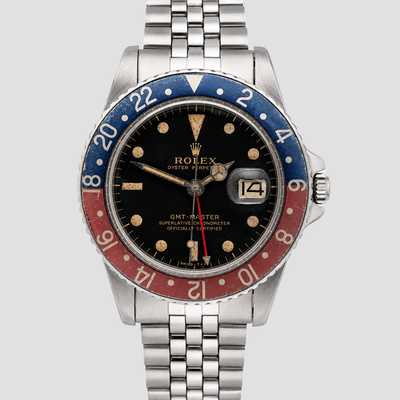
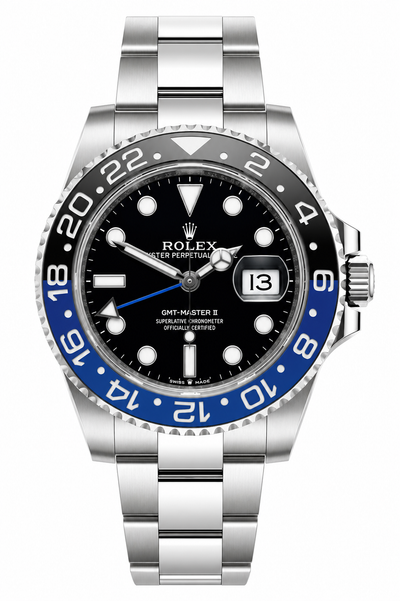
The most striking design element, which is also the reason the Black Bay GMT (reference 79830RB) and the GMT-Master II Pepsi are directly compared, is undoubtedly the red and blue bezel. On both watches, the lower half of the bezel is a vibrant red, while the upper half features a shade of blue, slightly darker on the Tudor than on the Rolex. Another small but significant difference: the teeth on the rotating bezel are coarser on the Rolex, and the numerals on the bezel are slightly larger.
Looking further towards the dial, the deep black color, the triangular, rectangular, and circular indices, the red GMT hand, and the luminescent coating on the hands and indices reveal obvious similarities. Like the numerals on the bezel, the indices on the Tudor are also narrower than those on the Rolex model. Furthermore, unlike the Rolex date display, the Black Bay GMT does not use a Cyclops lens.
In terms of size, the two models are separated by exactly one millimeter in diameter: the Rolex measures 40 centimeters, while the Tudor measures 41. The difference in weight is more significant. The GMT-Master II Pepsi weighs in at 142 grams, while the Black Bay GMT, at 186 grams, is a bit of a heavyweight.
Despite the aforementioned differences in design between the GMT luxury watches, a striking visual similarity is undeniable. This extends far beyond the two-tone bezel. Ultimately, both models possess a sporty, functional character with a healthy dose of elegance.
Material differences between Rolex Pepsi and Tudor Black Bay GMT
In terms of material selection, the Rolex Pepsi and Tudor Black Bay GMT look like this:
· Case: Tudor uses 316L stainless steel, Rolex its own 904L Oystersteel alloy, which is said to be particularly corrosion-resistant and durable thanks to a higher proportion of chromium and molybdenum.
· Bracelet: The Tudor watch comes with an Oyster bracelet and is alternatively available with a leather or textile strap; the Rolex can be purchased with an Oyster or Jubilee bracelet.
· Bezel: The bezel of the Rolex GMT watch is made of the patented Cerachrom ceramic material, while the Tudor model has an aluminum bezel.
Movement and functionality of Black Bay GMT and Pepsi
If you consider only the complications, the Rolex and Tudor models are virtually identical. Both luxury timepieces feature a second time zone and a date display. But do their movements execute these functions, as well as the time display, with the same precision and reliability? The short answer: Yes, absolutely.
The longer answer involves a closer look at the movements used. Inside the Rolex GMT-Master II ticks the tried-and-tested Calibre 3285, which boasts technically innovative components such as the Paraflex shock-absorbing system and the Chronergy escapement. However, the Tudor in-house movement MT5652 is also quite impressive. It features a silicon balance spring and, like the Rolex movement, is COSC-certified. Both calibres have a self-winding mechanism and offer the same power reserve of 70 hours.
So, in any case, we are dealing with two technically sophisticated, modern, and high-performance calibers. However, if one applies the highest standards and compares them with a discerning eye, the Rolex movement likely has a slight edge, at least in terms of its wealth of innovation.
Price difference: How much do Tudor and Rolex GMT watches cost?
Now things get interesting: How do the Tudor Black Bay GMT and the Rolex GMT-Master II Pepsi differ in price? Anyone familiar with these Swiss sister brands knows that a significant difference can be expected in this regard.
And indeed: The price difference, based on the manufacturer's list prices, amounts to €6,520. The Rolex costs €11,050 on an Oyster bracelet, while the Tudor costs €4,530 on the same bracelet. Choosing the GMT-Master II Pepsi on a Jubilee bracelet instead increases the price to €11,250, while the Tudor GMT model with a textile strap is available for slightly less – namely €4,210.
If a pre-owned model is an option, those who opt for the Tudor Black Bay GMT with a red and blue bezel have a chance of snagging a real bargain. On the secondary market, these watches can sometimes be found for as little as €3,000. In contrast, prices for the Rolex GMT-Master II Pepsi on the secondary market are generally above the list price. A new or like-new Pepsi often exceeds the €20,000 mark.
The HORANDO range constantly includes new and used luxury watches from the most prestigious and popular brands, including of course sought-after references from Rolex and Tudor – enjoy discovering!
Overview: Rolex Pepsi and Tudor Black Bay GMT in direct comparison
The following table clearly summarizes the most important information about GMT watches from Rolex and Tudor:
|
|
Rolex GMT-Master II Pepsi (Ref. 126710BLRO) |
Tudor Black Bay GMT (Ref. 79830RB) |
|
|
diameter |
40 millimeters |
41 millimeters |
|
|
Weight |
142 grams |
186 grams |
|
|
material |
904L-Oystersteel |
316L stainless steel |
|
|
bezel |
Cerachrom |
aluminum |
|
|
bracelet |
Oyster or Jubilé band made of Oystersteel |
Oyster, textile or leather strap |
|
|
clockwork |
COSC-certified automatic caliber 3285 |
COSC-certified automatic caliber MT5652 |
|
|
Power reserve |
70 hours |
70 hours |
|
|
Complications |
Date, second time zone |
Date, second time zone |
|
|
Waterproofing |
100 meters |
200 meters |
|
|
Luminous hands & -indices |
Yes |
Yes |
|
|
List price |
From €11,050 |
From €4,210 |
|
Decision-making aid: Black Bay GMT or Rolex Pepsi – how watch enthusiasts can make the right choice
If you're finding it hard to choose between the Tudor Black Bay GMT with a red and blue bezel and the Rolex GMT-Master II Pepsi, these questions can help you decide:
· Which watches are more to one's personal taste: bulky or slimmer? While neither watch is truly delicate, the Tudor is even more substantial than the Rolex in diameter, weight, and thickness. Those who find "too much watch" on their wrist bothersome in everyday life will likely be better served by the Rolex.
· Is water resistance important?
Neither the Tudor Black Bay nor the Rolex GMT-Master II is designed as a diver's watch, so water resistance is not the primary focus of either timepiece. However, the Tudor model, with a water resistance of 200 meters, offers better protection against water than the Rolex Pepsi, which is water-resistant to 100 meters.
· How much time should the search for the watch take?
If you want to own a Rolex Pepsi, you may have to be patient, as buying one through an authorized Rolex dealer usually involves waiting times, and demand on the secondary market also exceeds supply. Impatient watch enthusiasts should therefore opt for the Tudor, which boasts significantly better availability.
· What budget is available?
If your budget is tight, the Tudor Black Bay GMT is definitely the better choice. After all, for a comparatively low price, you get quality that can certainly compete with Rolex.
· Is the watch intended as an investment?
Those who view their new luxury watch as an investment should opt for the Rolex Pepsi. Considering the price trends of recent years, the Pepsi presents itself as a more promising investment than the Tudor Black Bay GMT.
Conclusion: Rolex, Tudor and the blue-red watch – who wins the GMT duel?
Without examining the two watches in detail, most people would probably assume, based solely on the brand names and price difference, that the Tudor Black Bay GMT couldn't hold a candle to the Rolex GMT-Master II Pepsi. However, a direct comparison reveals that the models are actually quite close in terms of design and performance. Nevertheless, the Rolex Pepsi is, of course, an established icon that the Tudor GMT watch certainly won't dethrone. But anyone looking for a worthy, more affordable alternative to the Pepsi won't be disappointed by the Black Bay GMT.
Discover the Black Bay GMT at HORANDO
You will find the current models in our Tudor Black Bay GMT collection, including the more compact 39-millimetre Black Bay 58 GMT. Our article Tudor watches: All model lines at a glance shows which other model lines Tudor offers.
FAQ
What does GMT mean on watches?
The abbreviation GMT stands for Greenwich Mean Time, the zero-hour standard of the London Royal Observatory on which the division of time zones is based. A GMT watch is based on this standard; it is a timepiece that displays a second time zone using an additional 24-hour hand.
Why is the Rolex GMT-Master II with a blue and red bezel nicknamed Pepsi?
The blue and red Rolex GMT-Master II model was nicknamed Pepsi because its color scheme is reminiscent of the logo of the caffeinated soft drink Pepsi.
Is Rolex better than Tudor?
It depends on the criteria used to compare the two brands. If prestige, brand recognition, and value are the main factors, Rolex watches are clearly superior. However, if the price-performance ratio is the benchmark, many watch connoisseurs would definitely choose Tudor.
Is the Rolex GMT-Master II Pepsi suitable as an investment?
Yes, the Rolex Pepsi is an extremely popular model that has proven to be extremely stable in value and represents an interesting investment option.
More from Buyer's Guide
All articles
Buyer's Guide Dress watch: Which watch goes with a suit – and which does not
Buyer's Guide Cartier Tank Alternative: The Best Rectangular Watches Compared
Buyer's Guide Rolex Alternatives: The Best Watches for Every Rolex Model