







Cartier
Jeweller to Kings – an icon of watch design
Total Items: 2
Sort
- Featured
- Most relevant
- Best selling
- Alphabetically, A-Z
- Alphabetically, Z-A
- Price, low to high
- Price, high to low
- Date, old to new
- Date, new to old


The rise, splendour and transformation of the house of Cartier
In 1888, Louis Cartier, son of the company’s founder, recognised the significance of the wristwatch and added to his range not only his own ladies’ models but also the products of other luxury manufacturers such as Vacheron Constantin. By the time the British court ordered no fewer than 27 diadems for the coronation of the then Prince of Wales, King Edward VII appointed him purveyor to the Crown and the London boutique was besieged by British high society, the house of Cartier had arrived on the Olympus of watchmaking. The markets of still-tsarist Russia also proved fruitful; in 1909 the Cartier store on New York’s Fifth Avenue was dressing the beautiful, the rich and the famous. The brilliant watchmaker created his homage to the aviation pioneer Alberto Santos-Dumont in 1904. The Cartier Santos is the very first true pilot’s watch, and in the nineteen-seventies it enjoyed a brilliant rebirth within the “Les Must de Cartier” concept. A watchmaking legend, much like the Tank and Pasha collections, which caused a sensation in the second decade of the twentieth century in the Art Déco style. Pasha was dedicated to the Sultan of Marrakesh, and this in turn awakened desires among the maharajas of far-off India. Over the first decades of the twentieth century further crowned heads acquired the same exquisite taste – Cartier’s ascent could no longer be halted. Until the extinction of the family line in the fateful year of 1965 led to the break-up of the family business. The “Monde Cartier” became the “Vendôme Luxury Group”. Yet none of this could diminish the aura of Cartier as a byword for sublime luxury and established wealth. It has long stood for a lifestyle that could hardly be more luxurious, and further luxury product segments were occupied long ago: perfume, eyewear, silk scarves, lighters, writing instruments and leather goods – precisely those refined incidentals without which no fashionable woman or man of the world may leave the house. The unadorned, classical design – unmistakably Cartier – implies elite, refined expectations. In 2009 Cartier celebrated its centenary in the United States, now under the roof of the luxury goods group Richemont. Cartier is the world leader in the jewellery segment.
A Cartier icon and a legacy of world watchmaking: the Cartier Santos
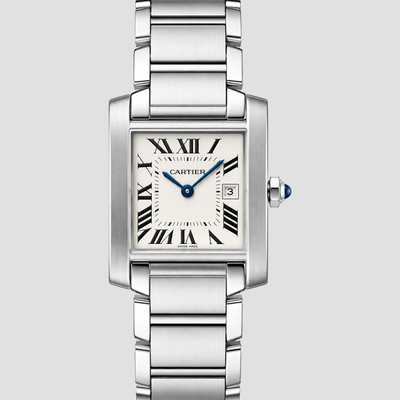
One might see it as an irony of history, but the emerging fields of aviation and the military at that time fueled the rise of the wristwatch. Traditional pocket watches on gold chains proved unusable during strenuous activities such as maiden flights or battles. The fact that ladies’ watches were worn on the wrist after the turn of the century was considered “unmanly” by men. Yet as early as 1880, Wilhelm I had wristwatches made for his naval officers. Starting in 1904, the Brazilian Alberto Santos-Dumont took to the skies on many test flights with the precursor to the Cartier Santos, and on November 12, 1906, the playboy and aviation pioneer wore “his” Santos on his wrist during his spectacular 220-meter powered flight. During World War I, the troops followed suit, and eventually the wristwatch made its way into civilian society as well. The first Cartier Santos broke with the conventions of the time—which dictated that a watch had to be round—and boldly presented a square, angular design with rounded corners, a raised glass bezel, and a leather strap. Today, the most famous men’s wristwatch in watchmaking history is available in three collections: the Santos de Cartier Galbée, the Santos 100, and the classic Santos-Dumont, which echoes this style with an alligator leather case and a narrower bezel. Complications? None, except for a date display on the Santos-Dumont. The Santos Galbée stands out with its signature small screws on the case and steel bracelet, as well as Roman numerals. Pure aesthetics for aesthetic purists. When watch diameters grew in the 1980s, Cartier’s dainty diameters seemed almost filigree-like. Today, they’re back in vogue, just like the two-tone versions, which had fallen out of favor for a time.
Luxury that is hard to surpass, precision for perfectionists
In 2009 Cartier presented its first entirely in-house automatic movement, its name, 1904MC, a reference to the year the Santos was born. A twin barrel enhances accuracy and power reserve, while the rotor that drives the automatic movement with every gesture rests on an innovative ceramic ball bearing. Cartier entered the realm of “haute horlogerie” with the development of the Astrotourbillon, in which the rate deviation caused by the earth’s gravity is compensated for by innovative mechanics. Cartier also occupies the concept watch segment, for instance with the extraordinary ID Two, in which a vacuum inside the transparent case makes screw fixings unnecessary.
Women in power at the house of Cartier
“Innovation” is the credo of Carole Forestier-Kasapi, Cartier’s head watchmaker today. Yet strong, sophisticated women were already in charge long before her. Jeanne Toussaint must have been blessed with absolute taste in the nineteen-twenties; she laid the foundations for the Must de Cartier, for it was the age of diamond-set cigarette holders, golden treasures and pretentious trinkets. In the nineteen-seventies Nathalie Hocq roused Cartier from its slumber. Her father, Robert Hocq, had acquired Cartier in 1972. His daughter pursued a carefully considered career before bringing fresh momentum to the old, if impeccably oiled, machinery in the Rue de la Paix. She was a sales and marketing talent with an unerring instinct for design, stones, exhibitions, people and markets. She negotiated in Arabian harems and in Fifth Avenue penthouses in New York. “Mademoiselle Cartier”, as she was respectfully known, and her habit of smoking black cigars, set the fashion. Today the international marketing director is Hélène Poulit, and in this country Patricia Gandji. Women hold leading positions in China, Korea, Mexico and Taiwan as well.
Other Cartier Categories at HORANDO: Tank Française


