


Buying a Rolex Day-Date: 36 or 40, Yellow, White or Rose Gold – References and Prices
Since 1956, the Rolex Day-Date has been the watch that spells out the day of the week in an arc above twelve o'clock. To this day it is only made in gold or platinum, never in steel. If you want to buy a Day-Date, you mainly decide on two things: the size and the metal. We show how the Day-Date 36 and 40 differ, what the reference number tells you and where prices stand at HORANDO.
Key facts at a glance
Precious metal only: The Day-Date is made exclusively in yellow gold, white gold, Everose gold and platinum.
Two sizes: The Day-Date 36 is the classic format, the Day-Date 40 the modern version.
One movement: Both sizes now use the automatic calibre 3255 with around 70 hours of power reserve.
Reading the reference: The last digit of the reference shows the metal, for example 8 for yellow gold and 9 for white gold.
Prices: At HORANDO, new Day-Date models start at around 45,000 euros; gem-set versions are considerably higher.
What defines the Day-Date
When Rolex introduced the Day-Date in 1956, it was the first wristwatch to display the day of the week spelled out in addition to the date. It came with the three-piece President bracelet, which Rolex introduced for this model. To this day, the combination of weekday, date under the Cyclops lens and fluted or smooth bezel is the hallmark of the line. You will find an overview of all models in our Rolex Day-Date collection.
Day-Date 36 or Day-Date 40?
The Day-Date 36 is the original size and looks classic and understated on the wrist. It suits slimmer wrists and anyone who prefers a gold watch that is not too prominent. The Day-Date 40 was added in 2015 and is now the more popular size among men. It wears more modern and offers more space for dials in bold colours. Both sizes are water-resistant to 100 metres and have a screw-down case.
Yellow gold, white gold, rose gold or platinum
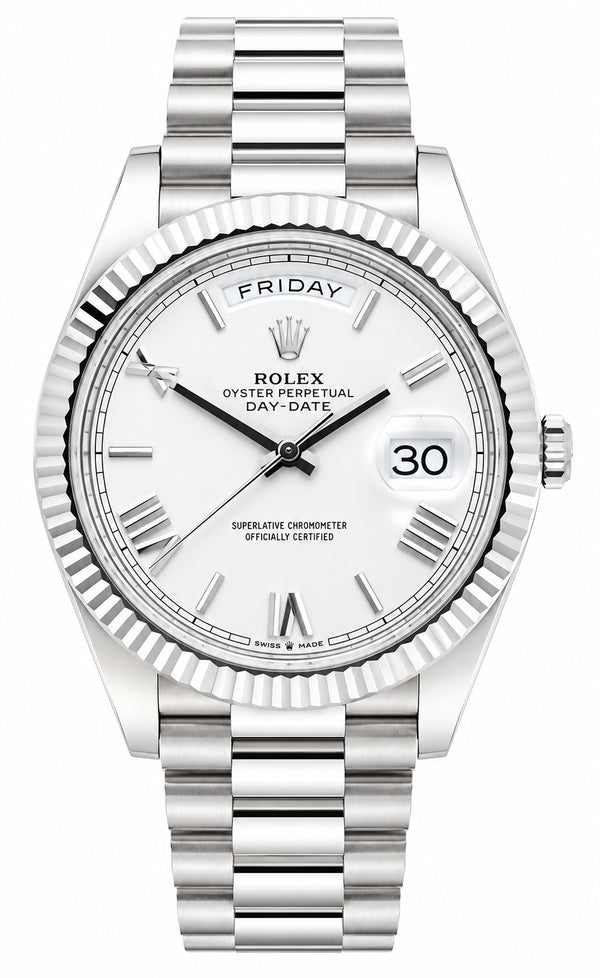
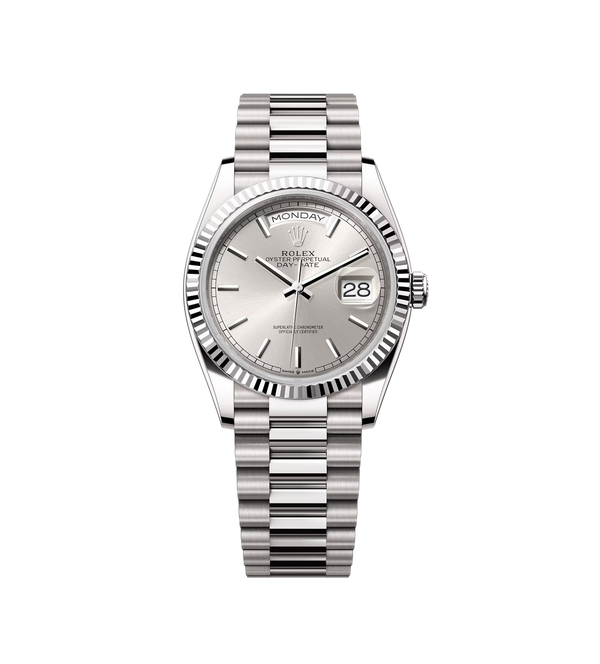
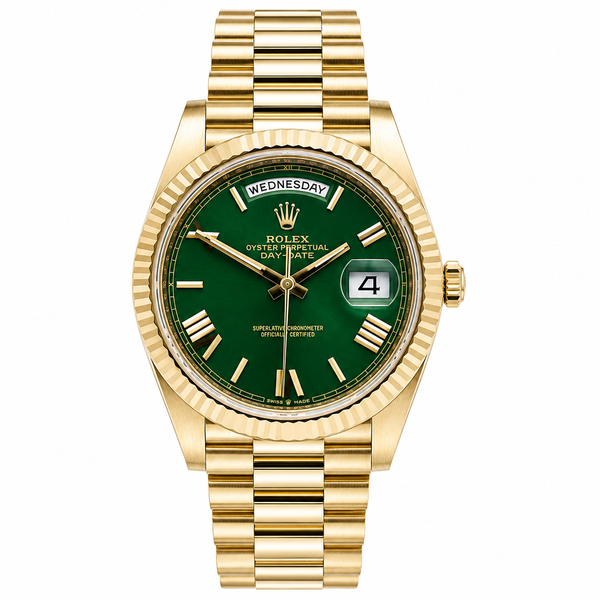
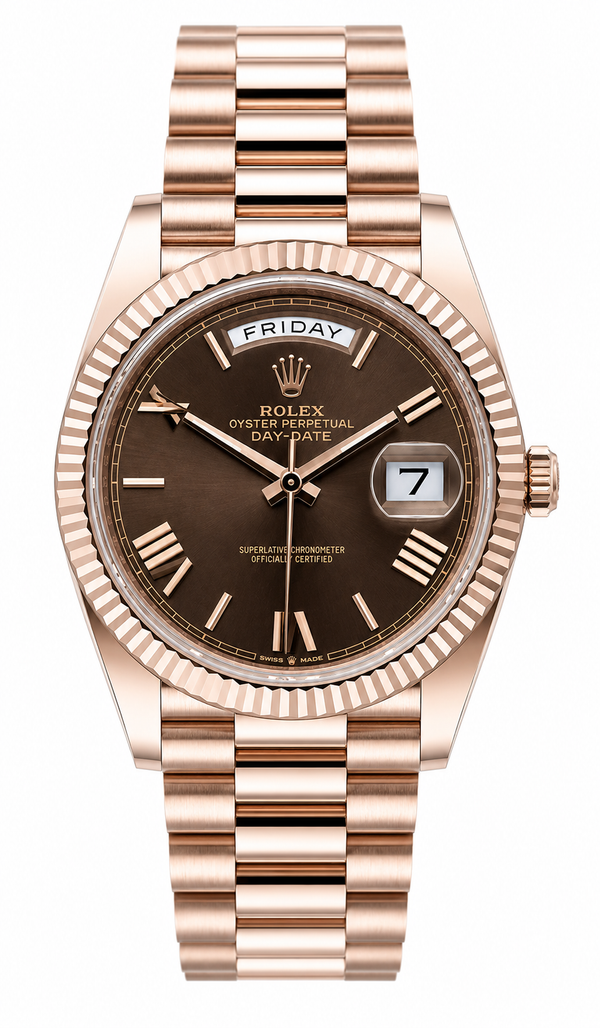
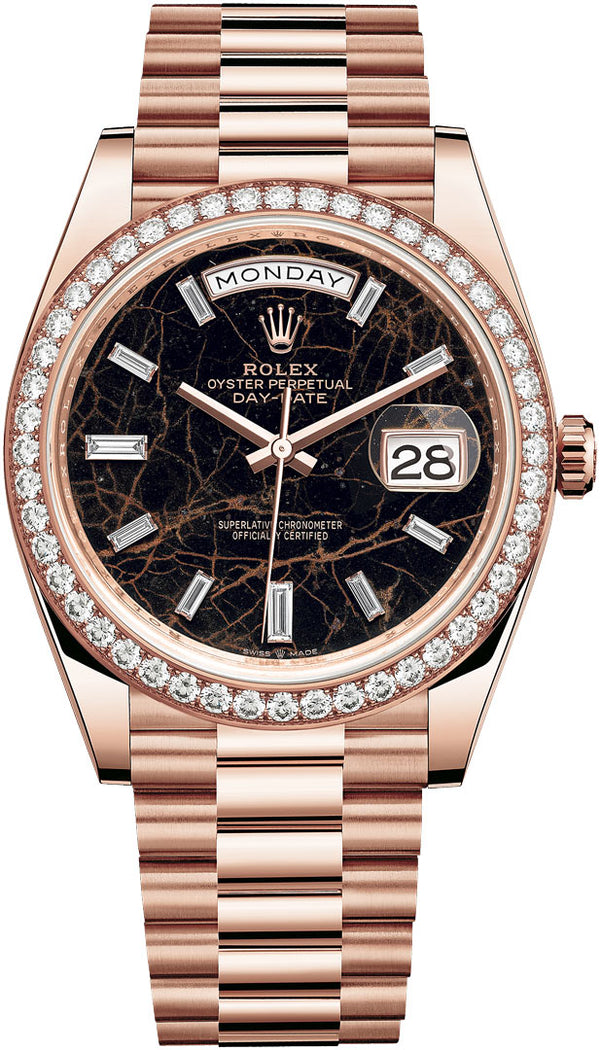
The metal shapes the character of a Day-Date more than with almost any other watch. Yellow gold is the classic and the version most people think of when they hear the name Day-Date. White gold looks almost like steel at first glance, making it the most discreet choice. Everose gold is Rolex's own rose gold alloy, designed to keep its warm tone permanently. Platinum is the heaviest and rarest version and at Rolex is usually recognisable by an ice-blue dial.
Understanding the reference number
The reference reveals size and metal. In the current generation, the Day-Date 40 begins with 2282 and the Day-Date 36 with 1282. The last digit stands for the metal: 8 for yellow gold, 9 for white gold, 5 for Everose gold and 6 for platinum. A 228239 is therefore a Day-Date 40 in white gold, a 128238 a Day-Date 36 in yellow gold. The suffix after the hyphen denotes the dial and bracelet. Read more in our article Rolex reference numbers.
How much does a Rolex Day-Date cost?
At HORANDO, new Day-Date models without gemstones usually cost between 45,000 and 60,000 euros. The table shows examples from our range:
| Model | Reference | Metal | Price at HORANDO |
|---|---|---|---|
| Day-Date 36 | 128239-0005 | White gold | 45,900 euros |
| Day-Date 40 | 228239-0046 | White gold | 45,790 euros |
| Day-Date 40 | 228238-0061 | Yellow gold | 51,900 euros |
| Day-Date 40 | 228235-0002 | Rose gold | 54,900 euros |
| Day-Date 40 Eisenkiesel | 228235-0045 | Rose gold | 66,900 euros |
Versions with diamonds or a gem-set bezel are considerably more expensive. How these prices compare with the Submariner, Daytona and GMT-Master II is shown in our Rolex price check 2026.

New or pre-owned?
A new Day-Date comes with a complete set and manufacturer's warranty. If you are looking for an older reference, our Certified Pre-Owned watches offer inspected pre-owned watches with a 1-year HORANDO warranty, for example a Day-Date 36 reference 1807 with a 2024 Rolex service for 13,900 euros. Older models usually have a smaller case and an earlier movement, but offer the charm of the vintage years.
If you would like to compare the Day-Date with its sister model, our guide Buying a Rolex Datejust will help. If you are looking for a similar watch outside Rolex, you will find ideas in Rolex Day-Date alternative.
Frequently asked questions
Is the Rolex Day-Date available in steel?
No. Rolex makes the Day-Date exclusively in yellow gold, white gold, Everose gold and platinum.
Which size is better, 36 or 40 mm?
The Day-Date 36 looks classic and suits slimmer wrists. The Day-Date 40 wears more modern and is now more popular among men. It is best to try both sizes on the wrist.
Which movement is inside the Day-Date?
Current Day-Date 36 and 40 models use the automatic calibre 3255, which offers around 70 hours of power reserve and is certified as a chronometer.
What does the last digit of the reference mean?
It stands for the metal: 8 for yellow gold, 9 for white gold, 5 for Everose gold and 6 for platinum.
Why is the bracelet called President?
Rolex introduced the three-piece President bracelet with the Day-Date. To this day it is closely linked to this model.
Conclusion
The Day-Date is Rolex's most classic gold watch. Decide on the size first and then on the metal: yellow gold for the classic, white gold for understatement, rose gold for a warm tone. The reference number shows you at a glance which version you are looking at. If you have questions about a specific Day-Date, our team will be happy to advise you.
More from Buyer's Guide
All articles
Buyer's Guide Watches as an Investment 2026: Which Models Hold Their Value
Buyer's Guide IWC Watch Prices 2026: What an IWC Costs – from the Mark XX to the Portugieser
Buyer's Guide How Much Does a Patek Philippe Cost in 2026? Nautilus, Aquanaut, Calatrava and Complications Price Check


