Moon Phase Watches: How the Moon Finds Its Way onto the Dial

On 12 August 2026 the Moon moved in front of the Sun. The umbra of the total solar eclipse swept across Iceland and northern Spain, among other regions, while a partial eclipse remained visible across large parts of Europe – and for a few minutes millions of people looked up. This is precisely the question that has occupied watchmaking for centuries: how do you depict the course of the heavens on a dial? The answer is the moon phase. In this article we explain how the complication works, what separates a good execution from a very good one, and which models from our selection of moon phase watches show particularly beautifully what lies behind this display.
The key points in brief
- The moon phase depicts a cycle of around 29.5 days. A disc bearing two moons rotates slowly behind an aperture in the dial, showing how much of the Moon is currently illuminated.
- Good executions deviate by a single day only after more than a hundred years. This is made possible by a more finely toothed gear ratio that comes considerably closer to the actual lunar month than the simple calculation based on 29.5 days.
- The moon phase is rarely on its own. It usually sits within a calendar movement – together with the date, day of the week and month – or complements a chronograph.
What the moon phase displays
The Moon takes around 29.5 days to travel from new moon via half moon and full moon back to new moon. The complication replicates this so-called synodic month. Beneath the dial lies a disc onto which two moons are applied. It rotates once per double month and is masked by an aperture in such a way that precisely the portion currently illuminated in the sky becomes visible in the opening. One tooth per day is enough for the mechanism – the advance is usually handled by the same gear train that also sets the date.
Why some moon phases are more accurate than others
The simple design works with a wheel that rounds the lunar month to 29.5 days. Since the actual cycle is somewhat longer, an error accumulates: after about two and a half years the display is a day out. More elaborate constructions use a more finely toothed wheel that comes much closer to the true lunar month. The difference is barely noticeable in everyday use, yet it says a great deal about a manufacture's ambition: it costs components, space and production effort – for a display that nobody strictly needs. That is exactly what makes the moon phase perhaps the most poetic of all watch complications.
A brief look back
Astronomical displays were among the very first additional functions. In the era of the great pocket watches, the moon phase was not decoration but a tool: it helped with planning sowing and harvesting and was relevant to seafarers, because the Moon governs the tides. Once movements became small enough in the 20th century, the display moved to the wrist – and lost its practical purpose without losing any of its fascination.
Four moon phase watches that approach the subject differently
From the classic calendar chronograph to the slim manufacture watch in rose gold: these four models show the breadth of the complication.
Longines Master Collection Chronograph Moon Phase 40mm. Moon phase, day of the week, month, date and chronograph on a silver dial – and the display still remains orderly. Driven by the automatic calibre L687 with 54 hours of power reserve, in a 40mm steel case behind sapphire crystal. Anyone looking for a classic entry into the calendar watch will find it here and in the wider selection of Longines moon phase watches.
Baume & Mercier Clifton Moon Phase 39mm. Blue dial, alligator leather strap, 39mm steel – and an automatic calibre with 120 hours of power reserve. Put the watch down on Friday and you will find it still running on Monday. The most restrained variant in the field and at the same time the most suitable for everyday wear.
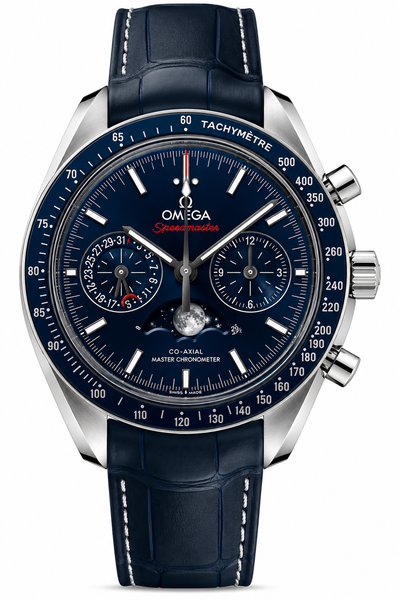
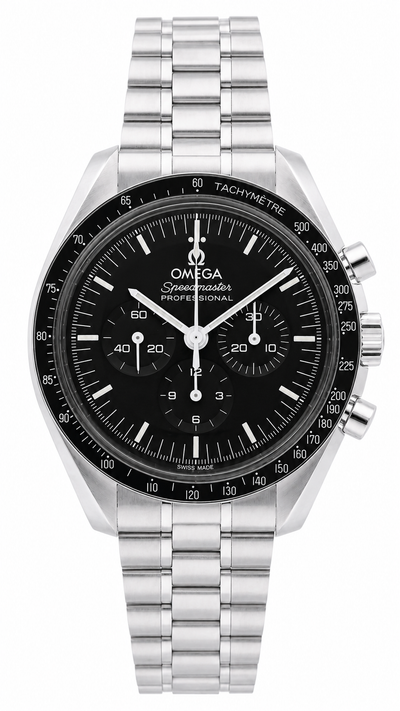
Omega Speedmaster Moonwatch Moonphase Chronograph. The Speedmaster is the watch whose predecessor flew to the Moon in 1969 – here it brings the Moon straight onto the dial as well. Chronograph, date and moon phase work with the automatic calibre 9904 and around 60 hours of power reserve; the case measures 44.25mm and is water-resistant to 100 metres. You will find further versions among the Omega watches.
Jaeger-LeCoultre Master Ultra Thin Moon. Rose gold, cream-coloured dial, 39mm – and a moon that fits into the display almost incidentally. The automatic calibre 925 delivers around 70 hours of power reserve. The most classical interpretation of the subject, complemented by further Jaeger-LeCoultre moon phase watches.
Two further recommendations
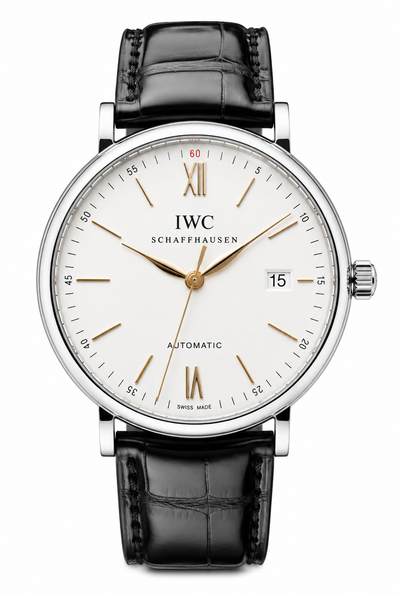
If you would like the calendar in full, the IWC Portofino Complete Calendar Moon Phase 41mm offers a particularly calmly drawn solution; the selection of IWC moon phase watches provides an overview. And the Glashütte Original PanoMaticLunar shows how independently German watchmaking handles the subject: a large date, off-centre time display and moon phase produce a dial you recognise immediately.
Moon phase in comparison
| Design | Deviation | Typical of |
|---|---|---|
| Simple moon phase | One day after around two and a half years | Classic calendar watches |
| Precise moon phase | One day after more than a hundred years | High-end manufacture calibres |
| Moon phase in a perpetual calendar | One day after more than a hundred years | Grand complications |
What to look for when buying
Three points make the difference in everyday use. First, legibility: a calendar dial quickly carries five displays, and not every design stays calm in the process. Second, operation: many calendar watches are corrected via recessed pushers in the case flank, for which a small tool is needed – and no adjustments should be made during the blocked period around the date change. Third, the power reserve: if the watch stops, the date, day of the week, month and moon all have to be set again. Models with a long power reserve, or a watch winder, spare you this work.
Conclusion
The moon phase is the complication that has the least to accomplish and therefore tells the most. It is a reminder that timekeeping has its origin in the observation of the sky – and that a mechanical watch keeps pace with this rhythm over decades, entirely without electronics. If you are looking for a model, our selection of moon phase watches provides the overview, while the luxury watches show a broader spectrum.
Frequently asked questions (FAQ)
How accurate is a moon phase display?
That depends on the design. Simple executions deviate by a day after about two and a half years, more elaborate constructions only after more than a hundred years. In everyday use both reliably show which phase the Moon is currently in.
How do I set the moon phase correctly?
As a rule via a recessed pusher in the case flank, for which a small tool is supplied. The last full moon serves as the starting point: you keep advancing the display until the full moon sits centrally in the aperture, and then count the days up to today.
May I correct the moon phase at night?
Better not. In the hours around the automatic date change, the switching parts are engaged with one another. Corrections should be made outside this window, usually in the morning.
Does a moon phase watch need more servicing?
The more components a movement contains, the more carefully it should be serviced. A professional overhaul at the recommended interval preserves both function and value – but the intervals themselves barely differ from those of a watch without a calendar.
More from News from the watch world
All articles
News from the watch world Geneva Watch Days 2026: 71 Brands, Five Days in Geneva – and Which of Them You Can Wear Today
News from the watch world Small Watches, Big Impact: Why 34 to 38mm Are Making a Comeback