Made in Glashütte: What German Manufacture Watches Do Differently

On 23 August 2026, Glashütte Original presented two new versions of the Senator Chronograph – and in doing so drew attention back to a place that is smaller than many a city district: Glashütte in the eastern Ore Mountains, with around 7,000 inhabitants. Since 1845 it has been home to a school of watchmaking with a signature of its own, one you recognise in the movement before you read the dial. In this article we explain how to identify a Glashütte movement, why the indication of origin is protected – and which models from our selection of luxury watches illustrate the subject particularly well.
The key points in brief
- Glashütte is a protected indication of origin. A substantial part of the value creation on the movement has to take place locally – which makes the designation more than a marketing addition.
- Three construction features shape the style: a three-quarter plate instead of individual bridges, a swan-neck spring for fine adjustment and a hand-engraved balance cock.
- The large date comes from Glashütte. A. Lange & Söhne introduced it in 1994 with the Lange 1, inspired by the five-minute clock of the Semper Opera House in Dresden.
One town, an entire industry
In 1845 Ferdinand Adolph Lange moved his watchmaking business to the then impoverished mining town of Glashütte and trained apprentices there. Within a few decades this settlement gave rise to a complete network of workshops, suppliers and a watchmaking school of its own. After the Second World War the companies were expropriated and merged into a state-owned combine; only after 1990 did independent manufactures emerge from it again. A. Lange & Söhne was re-established, Glashütte Original grew out of the combine. Both houses work with their own calibres today – and both are listed with us: in the selection of Glashütte Original watches and at A. Lange & Söhne.
How to recognise a Glashütte movement
The first glance goes through the display back. Instead of individual bridges, as are customary in the Swiss tradition, a Glashütte movement frequently carries a three-quarter plate: a large, continuous plate that covers a large part of the gear train. It is more demanding to assemble, because several pivots have to find their bearings at the same time, but it gives the movement greater stability.
Added to this are the swan-neck spring, a curved spring with which the regulator can be finely adjusted, and the hand-engraved balance cock – a detail that makes every watch a one-off, because no engraving is identical to another. Surfaces are traditionally finished with Glashütte ribbing, screws are blued. None of this measurably improves rate accuracy. All of it costs working hours. That is precisely the difference that manufacture movements make in general as well.
Four watches from Glashütte
From the steel diver's watch to the icon in platinum: these four models show the breadth of the field.
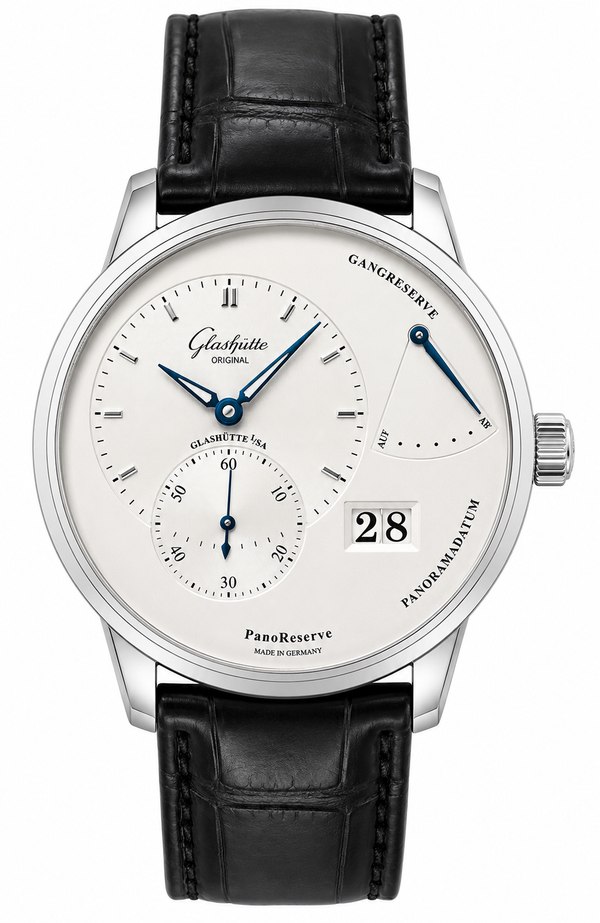
Glashütte Original PanoReserve. The Pano line moves every display away from the centre: hours and minutes on the left, small seconds on the right, the large date at two o'clock – a layout that follows the golden ratio. Via a dedicated indicator, the hand-wound calibre 65-01 shows how much of its 42 hours of power reserve is left. 40 mm stainless steel, silver dial, alligator leather strap with a folding clasp.
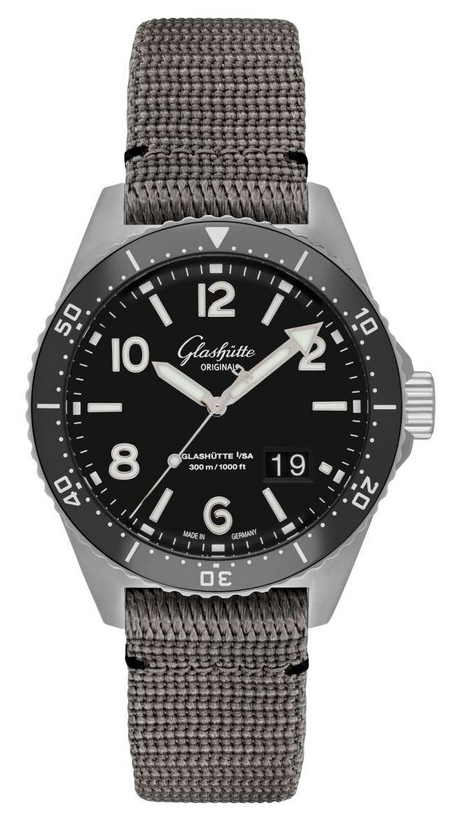
Glashütte Original SeaQ. The sporting side of the manufacture: 43.2 mm stainless steel, black dial, sapphire crystal with anti-reflective coating on both sides and water resistance to 300 metres. Inside, the automatic calibre 36-13 works with around 100 hours of power reserve – four days during which the watch keeps running even when it is set aside.
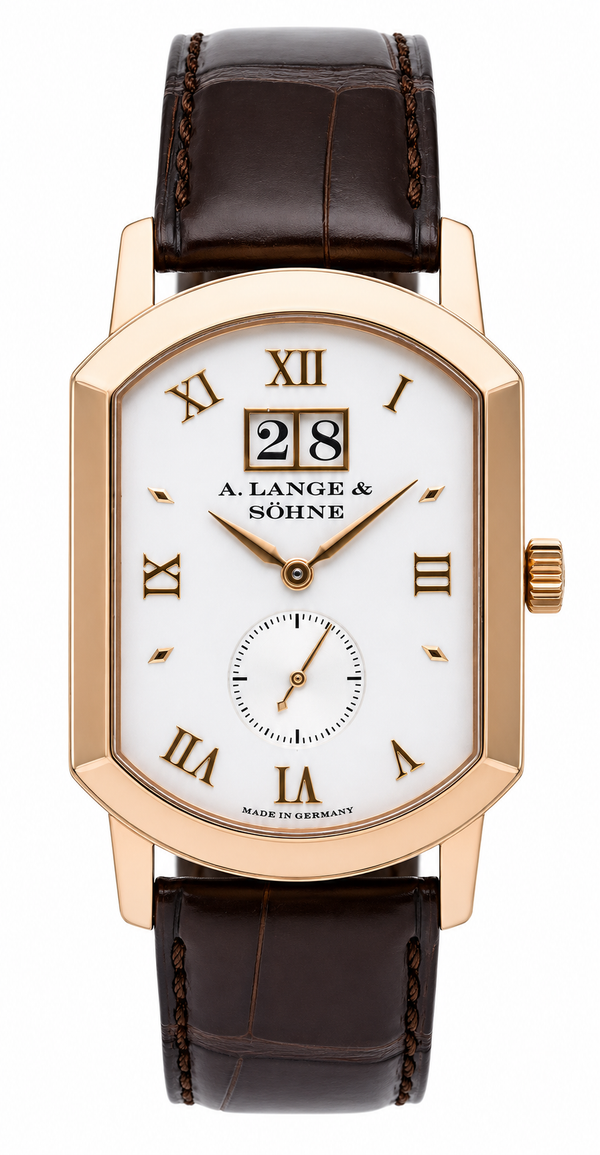
A. Lange & Söhne Grand Arkade. A tonneau-shaped case in rose gold, 28 by 37 millimetres – a form the house uses only rarely. White dial, hand-wound movement with 42 hours of power reserve, small seconds and date. A certified pre-owned model whose authenticity and condition our watchmakers have checked.
A. Lange & Söhne Lange 1. The model with which the manufacture returned in 1994. The asymmetrical dial arranges the time display, small seconds, power reserve and large date in such a way that no indication overlaps another. 38.5 mm platinum, hand-wound movement with 72 hours of power reserve, display back onto the hand-finished movement.
Glashütte and Switzerland compared
| Feature | Glashütte tradition | Swiss tradition |
|---|---|---|
| Movement architecture | Frequently a three-quarter plate | Mostly individual bridges |
| Fine adjustment | Swan-neck spring | Frequently regulating screws on the balance |
| Decoration | Glashütte ribbing, engraved balance cock | Geneva stripes, perlage |
| Typical date display | Large date in two windows | Single date window |
What to look for when buying
Three points are worth your attention. First, the display back: with Glashütte watches it is not an accessory but the actual reason for the premium – anyone who does not value the view of the movement is paying for work they will never see. Second, the winding system: many classics from Glashütte are hand-wound watches. That is a deliberate decision in favour of a slimmer movement and an unobstructed view, but it calls for daily attention. Third, servicing: manufacture calibres are overhauled by the houses themselves or in authorised workshops; the intervals barely differ from those of other mechanical watches, and the supply of spare parts is tied to the brand.
Conclusion
Glashütte is not a second Geneva, but a school of its own. You recognise it by constructions that nobody strictly needs and that you only understand when you look at the movement – and by the fact that a town of 7,000 inhabitants has practised the same craft for 180 years. If you would like to look at this more closely, you will find an overview at Glashütte Original and A. Lange & Söhne; the broader spectrum is shown by our luxury watches.
Frequently asked questions (FAQ)
What does the indication of origin “Glashütte” mean?
It may only be used if a substantial part of the value creation on the movement actually takes place in Glashütte. Merely assembling bought-in movements is not enough.
What is a three-quarter plate?
A large, continuous plate that covers a large part of the gear train in place of several individual bridges. It increases the stability of the movement and is characteristic of Glashütte watchmaking.
Why do many Glashütte watches have a large date?
Because A. Lange & Söhne brought it to the wristwatch in 1994 with the Lange 1 – as an allusion to the five-minute clock in the auditorium of the Semper Opera House in Dresden. Other houses in the town took up the display later on.
Do German manufacture watches hold their value?
As everywhere, that depends on the model, the condition and the completeness of the papers. Classics in small production runs and models in precious metal are considered more robust in value than widely produced series – but that is no guarantee.
More from Buyer's Guide
All articles
Buyer's Guide Dress watch: Which watch goes with a suit – and which does not
Buyer's Guide Cartier Tank Alternative: The Best Rectangular Watches Compared
Buyer's Guide Rolex Alternatives: The Best Watches for Every Rolex Model