Old Money Watches: What an Old Porsche, Loro Piana and a Patek Have in Common

Old Money, New Money: both are Porsches, and they say opposite things. The same applies to watches.
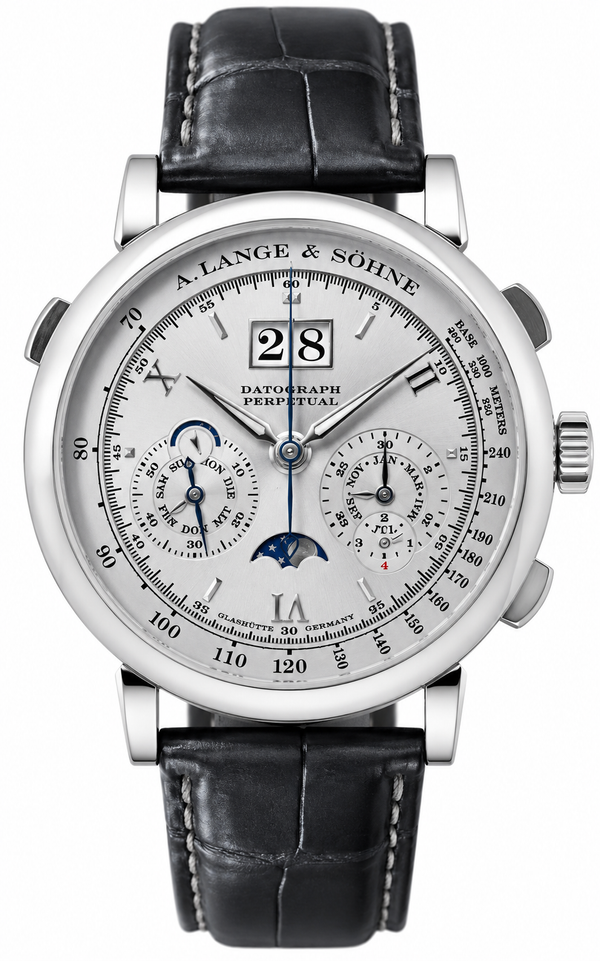
The most expensive watch in this article costs EUR 99,000 and looks like steel. A platinum case, a silver dial, Roman numerals – from three metres away, a plain white watch. Those who recognise it know that it contains a perpetual calendar, a flyback chronograph and a big date. Everyone else sees nothing special. That is exactly the point.
With watches, Old Money is not a brand or a budget, but a register. It is decided by case height, diameter, material and strap – and by whether a watch already has its time behind it. This article goes through that register model by model, with prices from our inventory.

What it is about, in one row: from the IWC Portofino at €4,430 to the A. Lange & Söhne Datograph Perpetual at €99,000. The most expensive one is the one you notice least.
In short: With watches, Old Money does not refer to a brand but to a register: slim cases, diameters between 36 and 39 millimetres, understated materials, often leather instead of a steel bracelet and frequently a model with history rather than a new piece. Typical examples are the Jaeger-LeCoultre Reverso, the Patek Philippe Calatrava, the Cartier Tank and the IWC Portofino. What matters is the model, the version and the context, not the price.
Contents
- Why the most expensive watch in the room is the quietest
- What the market says
- The rectangular school: Reverso and Calatrava
- The slim case: Santos, Tank and Portofino
- The value of the worn: Daytona 16520
- The exception: Submariner
- The other register: Aquanaut, chronograph, GMT
- Four adjustments that change everything
- The same language: clothing, cars, watches
- The brand that turned inheritance into a promise
- Why provenance is worth more than condition
- A caveat that belongs here
- What remains
- The models from this article
- Frequently asked questions
Why the most expensive watch in the room is the quietest
The A. Lange & Söhne Datograph Perpetual is a good example precisely because it looks so little like one. Platinum is heavier than gold, costs more and looks like steel. Whoever wears this watch is wearing EUR 99,000 on their wrist without anyone noticing who does not already know.
There is an economic reason why this can be appealing at all. In 1899, the economist Thorstein Veblen described conspicuous consumption: the wealthy show their wealth through things that are visibly expensive and visibly useless. For over a century, this worked.
In 2017, the sociologist Elizabeth Currid-Halkett described why it stopped working. Luxury has been democratised – financeable, leasable, attainable pre-owned. As a result, visible status symbols lose precisely the function they were intended for: they no longer separate anyone from anyone. The code migrates into things that only those who already belong can recognise. With watches, that means: away from the logo, towards the detail.

Perpetual calendar, flyback chronograph and big date in a platinum case – a metal that looks like steel. A. Lange & Söhne Datograph Perpetual, Ref. 410.025D, €99,000.
What the market says
This sounds like a style column, but it is measurable. In 2024, Bain & Company recorded the first decline in the personal luxury goods market in 15 years. In the same environment, it was the quiet brands of all things that grew by double digits.
In the watch industry, the pattern is even clearer. The annual report by Morgan Stanley and LuxeConsult estimates the 2025 revenues of the fifty largest Swiss brands:
Brand |
Revenue 2025 (CHF) |
Rolex |
11.0 bn |
Cartier |
3.5 bn |
Audemars Piguet |
2.6 bn |
Patek Philippe |
2.5 bn |
Omega |
2.2 bn |
Longines |
0.92 bn |
The most remarkable figure is in the second row. Cartier – the house of rectangular cases and slim dials – increased its market share from 5.7 percent in 2019 to 8.7 percent in 2025, selling around 695,000 watches in the process. No loud model, no explosion of colour, no limited collaboration. A rectangle that has existed almost unchanged since 1917.
While the overall market shrank, the brand that looks least like a status symbol gained ground.
The rectangular school: Reverso and Calatrava
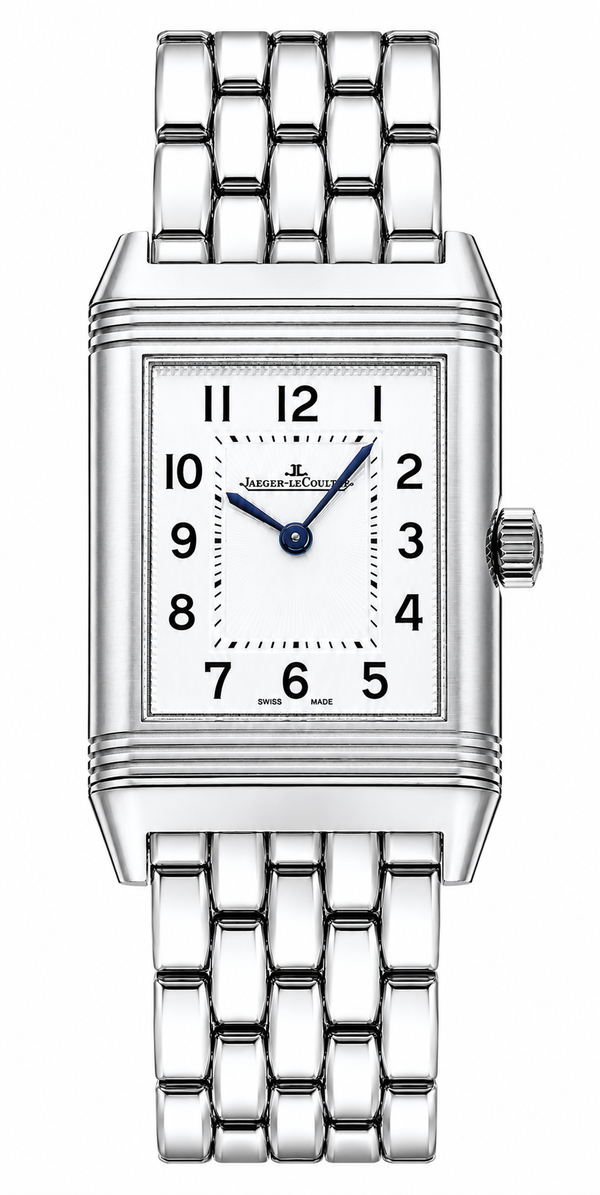
The most formal register begins with two watches that both arose from a problem. The Jaeger-LeCoultre Reverso came about in 1931 from a concrete nuisance: British officers playing polo in India were smashing their watch crystals one after another. The solution was a case that can be flipped within its frame so that the solid caseback faces upwards. An engineering answer that happened to become one of the most beautiful watches of the 20th century – and whose closed back remains the most popular engraving surface in the watch world to this day. Hardly any other model is passed down as often.
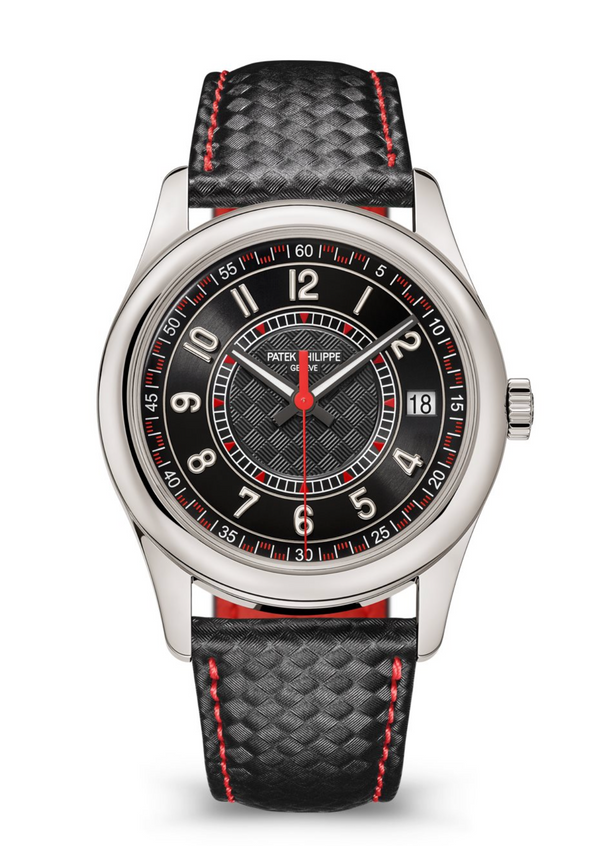
The Patek Philippe Calatrava followed a year later, in 1932, with reference 96. It follows the same logic from the opposite direction: leave things out until nothing superfluous remains. A round case, a clear dial, slim enough to disappear under any cuff. The diameter was 31 millimetres – completely normal at the time, a statement today. The Calatrava is the reason “dress watch” is a category at all.

Two schools: the rectangle goes back to Cartier and the early 20th century, the round shape to the pocket watch. Both are considered classic – they simply say different things.
Neither can be recognised from across the table. That is not a weakness but the function. In our inventory, this register starts with the Reverso Classic, Ref. 2618141, at €7,180; the Calatrava, Ref. 6007G-010, is at €44,900.

Rectangular, slim, barely visible under the cuff: the Reverso Classic Monoface Small Seconds, Ref. 3858523, €9,690.
The slim case: Santos, Tank and Portofino
The second register is the quietest: slim case, clear dial, nothing that stands out first in a photo. It has three founding fathers. The Cartier Santos was created in 1904 because the aviation pioneer Alberto Santos-Dumont complained to his friend Louis Cartier that he could not possibly pull out a pocket watch in the cockpit. Cartier built him a watch with a flat, angular case and a leather strap – one of the first wristwatches a man could wear in everyday life without having to justify it.

Visible screws, square case, steel: the Santos de Cartier, Ref. WSSA0063. The screws were originally part of the construction; today they are its signature.
Thirteen years later came the Tank, inspired by the top view of a tank on the Western Front. It is the best proof of the thesis. Jackie Kennedy wore a Tank from 1962, a gift from her brother-in-law Stanisław Radziwiłł; in 2017, Christie’s in New York auctioned exactly this piece for 379,500 dollars. Andy Warhol owned a Tank Louis and declared that he did not wear it to tell the time – he never wound it anyway. After his death, around 300 watches were found in his drawers, of which the public had known nothing. A collection no one was supposed to see: the principle in its purest form.
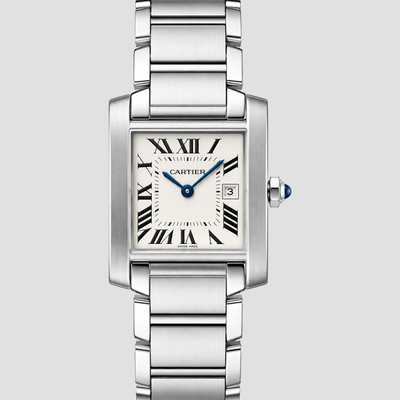
Entry into this register is more attainable than the tone of the subject might suggest: the Cartier Tank Française, Ref. 2465, is at €2,590.

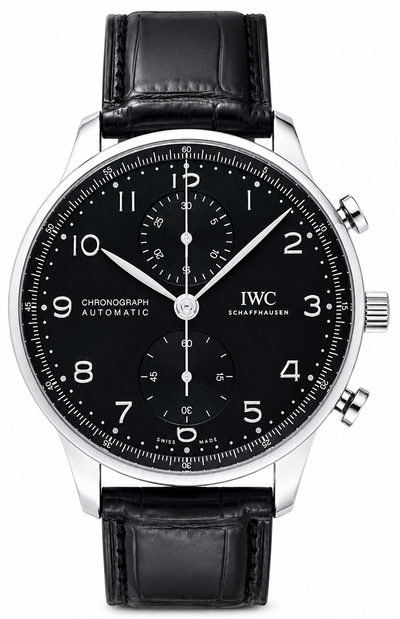
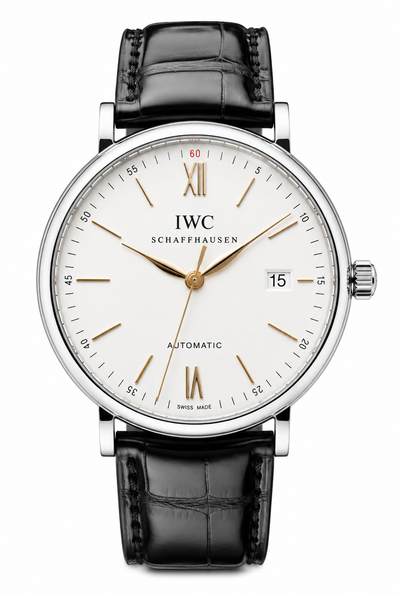
Large calm dial, slim case, alligator strap: IWC Portofino Automatic, Ref. IW356501, €4,430.
The third founding father is younger. The IWC Portofino arrived in 1984 and is named after the Ligurian fishing village – a large, calm dial with very little on it, and a slim case. All three work for the same reason: they make no claims.
Cartier itself shows that this register is not tied to steel. A Pasha Chronograph in yellow gold with two rows of brilliant-cut diamonds would be a statement at almost any other house. At Cartier, it remains restrained through its proportions, white dial and Roman numerals. Material and stones alone are not decisive – the design language is.

Yellow gold and two rows of brilliant-cut diamonds – and still no break in tone: Cartier Pasha de Cartier Chronograph, Ref. 13541, €9,790.
The value of the worn: Daytona 16520
The third register is not measured by flawlessness but by use. Its watch is therefore not a new one.
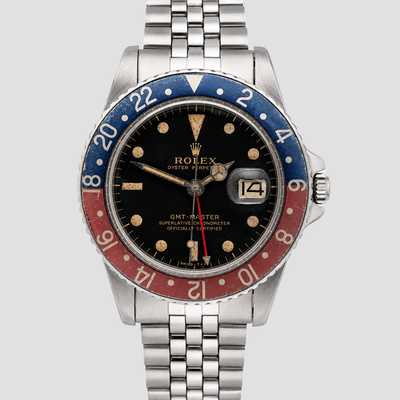
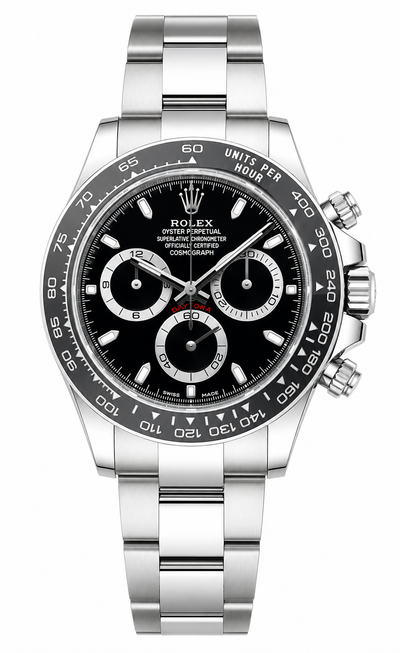
The Rolex Cosmograph Daytona reference 16520 was produced from 1988 to 2000 and marks a turning point: it was the first Daytona with an automatic movement. Rolex did not develop its own calibre for it but bought one from Zenith – the El Primero, at the time the most precise series-production chronograph movement in the world. Rolex disassembled it, replaced a large proportion of the components and reduced the frequency from 36,000 to 28,800 vibrations per hour, in favour of smoother running and longer service intervals. The result is called calibre 4030 and gave the watch its collector's name: Zenith Daytona.

Rolex Cosmograph Daytona Ref. 116520 in steel – the successor to the Zenith reference 16520. The 16520 has been out of production since 2000; available references can be found in the Daytona collection, and our Concierge Service sources specific vintage references.
The list price at the time of production was around 5,500 US dollars. Today the market value is around EUR 27,000 to 31,000, depending on condition. Production ended a quarter of a century ago, and supply can no longer grow. That is exactly why, in this context, the 16520 is stronger than any current reference: it looks as if it has already belonged to someone, because it has.
The exception: Submariner
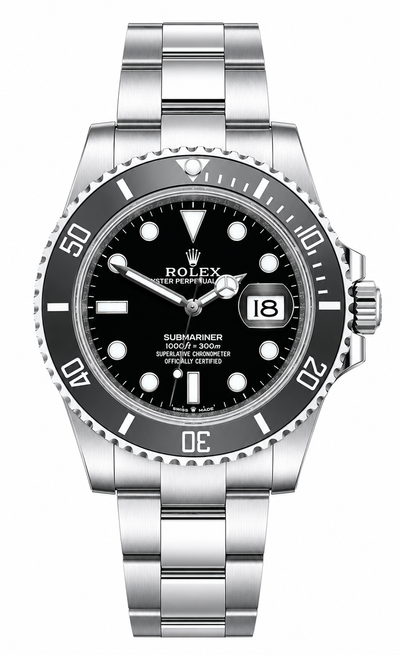
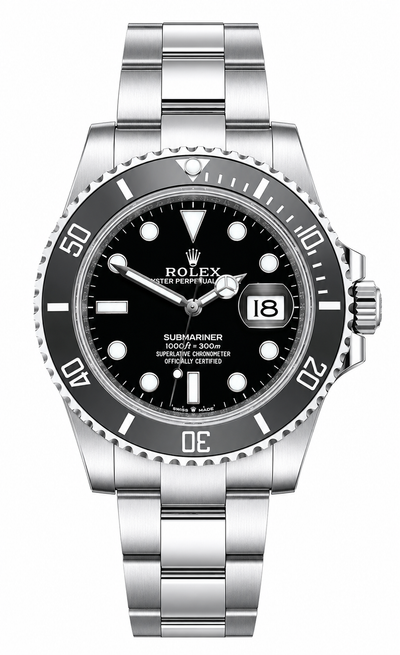
Every classification has its exception, and with watches it is called the Rolex Submariner. In the range since the early fifties and barely changed in its basic form since then, it works on the wrist of an heir just as it does on that of a self-made entrepreneur. It is the only sports watch that looks out of place in no register.
Within the line, however, the same logic applies as everywhere else. A current reference with a ceramic bezel and polished flanks is a purchase of today. An older one with an aluminium bezel, darkened luminous dots and softly worn edges stands for decades on the same wrist and for being passed on to the next.

Three Submariners, three decades: on the left a current reference with ceramic bezel, on the right an older date version with aluminium bezel and darkened luminous dots, below one without date.
A look at our inventory shows how little this has to do with price: a Submariner Ref. 5508 from the late fifties is at €49,000, a current Submariner Date in yellow gold, Ref. 126618LN, at €46,900. Almost the same amount – and two completely different statements.

The counter-test in yellow gold: Submariner Date, Ref. 126618LN, €46,900 – almost the same amount as the reference 5508 from 1958.
The other register: Aquanaut, chronograph, GMT
There is another side, and it has its place. The Patek Philippe Aquanaut of 1997 was the younger answer to the Nautilus: the same house, the same level, but with a grained dial and a composite strap that Patek calls “Tropical”. Whoever wears it wears a Patek without it looking like an occasion. In our inventory it is at €99,900, the Flyback Chronograph, Ref. 5968G-010, at €119,900.
It gets louder with sports chronographs: larger case, high-contrast dial, ceramic or carbon, often an accent of colour. That is not the opposite of style but a different register. A Richard Mille is its most extreme form – a watch that does not hint at where it belongs but states it outright.
Nothing explains the difference better than two watches side by side. One bears sapphires, rubies and diamonds on its bezel and lugs; you recognise it in passing and immediately know what it cost. The other is a white gold case on a black alligator strap, with day, date, month, moon phase and power reserve. From two metres away it looks like an ordinary three-hand watch.

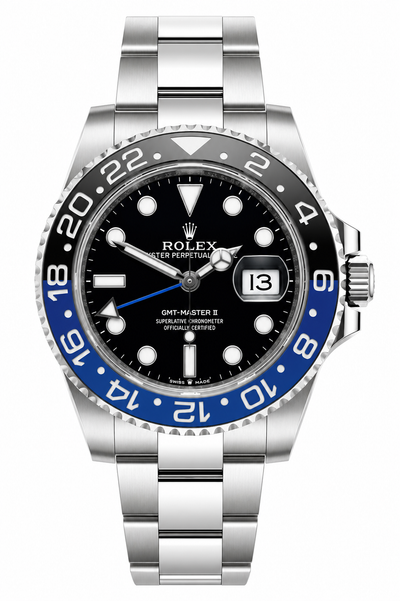
Two watches, one table: on the left a GMT-Master II with sapphires, rubies and diamonds, on the right a Patek Philippe Annual Calendar in white gold on an alligator strap.
The interesting part is the price. A GMT-Master II Gold Jubilee is at €48,900 with us, a Patek Philippe Annual Calendar with moon phase and power reserve, Ref. 5147G-001, at €63,490. The quieter watch is the more expensive one – and the only one of the two that no one outside the watch world recognises.
Four adjustments that change everything
Within the same model, the version is decisive. Four details shift the effect more than the brand does:
Strap: The same watch looks calmer on a leather strap than on a steel bracelet, and more casual on a textile strap than on either. Changing the strap costs a fraction of the watch and changes more than any other decision.
Case size: 36 to 39 millimetres read as classic, 42 and up as sporty. The Calatrava of the thirties measured 31 millimetres. What was standard then is considered deliberate understatement today — a good example of how codes shift without the object changing.
Material: Steel disappears, gold does not. Rose gold lies in between, and titanium recedes almost completely visually.
Signs of wear: A watch with patina tells of time. An aged dial, a worn strap, a scratched bezel signal ownership over years rather than a purchase last month. That is exactly why vintage watches are often the stronger choice in this style world than a new piece.

Three metals under the same light: platinum and white gold pass for steel on the wrist, yellow gold never does. This has nothing to do with price.

One case, two straps: sporty on the steel bracelet, calm on the leather strap. Switching costs a fraction of the watch.
The same language: clothing, cars, watches
What applies to the wrist also applies beyond it. The most discussed item of clothing in the series “Succession” was neither a watch nor a suit, but a baseball cap: plain, unlined, without print – and around 500 dollars, because it was made by Loro Piana. Reactions split into exactly two camps. Some found it absurd, others understood immediately. The cap has no logo because the logo would ruin the point.

Two logo-free caps, around 500 dollars each. Those who recognise the brand belong. Photo: HBO
The same series also provides the watch test. Costume designer Michelle Matland built the wardrobe according to one rule: follow the person, not fashion. For the watches, she was advised by Danny Milton of Hodinkee. The most powerful man in the room wears a Breguet Classique and an IWC Big Pilot's Watch – two watches no one identifies who does not already know. The Patek Philippe his son-in-law gives him in the pilot episode is later passed on by his assistant to the family of a groundskeeper, together with a non-disclosure agreement.

The series never shows which Patek is given away in the pilot episode. Pictured: Calatrava Pilot Travel Time Chronograph, Ref. 5924G-001, €67,900.
The son goes the opposite way: from Vacheron Constantin and a Patek Nautilus to a Richard Mille that can be recognised from ten tables away.
Whoever needs to be seen has already lost the position.
It works the same way with cars. Old Money doesn't just drive a Porsche – it matters which one. An air-cooled 911 from the eighties and an orange GT2 RS are both Porsches and say opposite things.
Read as a style interpretation rather than a set of rules, this results in five worlds:
Style world |
Car |
Clothing |
Watch |
British elegance |
Aston Martin DB5 |
Tweed, fine knitwear, suede |
Jaeger-LeCoultre Reverso or Patek Philippe Calatrava |
Relaxed classic |
Older Porsche 911 |
Worn-in jeans, Oxford shirt, unlined blazer |
Rolex Daytona 16520 |
Cultivated understatement |
Mercedes SL “Pagoda” |
Linen, cashmere, muted colours |
Cartier Santos or IWC Portofino |
Modern, sporty luxury |
Discreetly specified sports car |
Loro Piana, light jacket, simple sneakers |
Patek Philippe Aquanaut |
Visible performance |
Orange Porsche 911 GT2 RS |
Technical materials, sporty look |
Striking sports chronograph |
Feature |
Old Money |
New Money |
Case diameter |
36–39 mm |
42 mm and above |
Material |
Steel, white gold, platinum |
Yellow gold, ceramic, carbon |
Shape |
rectangular, tonneau, slim round |
round, tall, with bezel profile |
Strap |
Leather, textile |
Steel, rubber |
Condition |
worn, patina welcome |
unworn, protective film often still on |
Recognition |
only for connoisseurs |
from ten tables away |
Provenance |
inherited or bought vintage |
new from the dealer |
The brand that turned inheritance into a promise
No brand stands for luxury passed down as much as Patek Philippe – and that is no coincidence but a campaign. In 1996, the manufacture commissioned the London agency Leagas Delaney with an unusual brief: not to advertise the watches, but the people who wear them. The first ads in the series, which has since been called Generations, showed no watch at all, only black-and-white photos of fathers with sons and mothers with daughters.
The line was added in 1997 and remains the best-known line in watch advertising to this day: you never actually own a Patek Philippe, you merely look after it for the next generation. A purchase became a handover, a status symbol an heirloom.

Five Patek Philippe side by side: two Aquanauts on rubber straps – one of them orange –, a ladies' watch with diamond bezel and a classic small seconds. The same manufacture, four registers.
Interestingly, the manufacture itself does not consider this register the only correct one. Since 2024, Patek has been advertising with a second message: there is no star model, because not everyone who likes their watches likes the same watch. The thesis of this article could hardly be put more precisely – and it comes from the manufacturer itself.
Why provenance is worth more than condition
There is a point at which the question of style tips into a question of value.
$17.8m: Paul Newman's Rolex Daytona, Phillips 2017
$379,500: Jackie Kennedy's Cartier Tank, Christie's 2017
≈ 300: watches in Warhol's drawers that nobody knew about
Paul Newman's Daytona was technically the same watch that cost a few thousand dollars at the time. The price was not determined by the movement or the condition, but by the wrist it had been on.
Loulou Bontemps, costume designer of “The Gentlemen”, found the most concise way to put it: who wore a watch before can make a difference of millions. That is exactly why Old Money works with inherited objects rather than purchased ones. A watch from a father's estate has a quality that no new piece possesses – and it cannot be bought.
For those who have not inherited anything, there is the second-best solution: buy a watch that already has this time behind it. Inspected pieces with a one-year warranty are available under Certified Pre-Owned.

Perpetual calendar, moon phase, big date and flyback on 41 millimetres – and not a single element that stands out from three metres away.
A caveat that belongs here
We are assessing aesthetics here, not the character of the owner. The same person can own a Calatrava and a sports chronograph. What is interesting is not what someone is, but which side they show on a particular day.
An old Daytona remains a Rolex. An Aquanaut remains a Patek. They simply speak different languages.
What remains
Old Money is not a brand or a budget, but a way of reading. It rests on the fact that luxury is now within reach of so many that visible status symbols have lost their distinguishing effect. Those who understand this choose differently: slimmer, smaller, more discreet in material and preferably with history rather than without.
The figures confirm the direction. Cartier increased its share of the Swiss watch market from 5.7 percent in 2019 to 8.7 percent in 2025, while the overall market was under pressure. And in our inventory, a Submariner from the late fifties at €49,000 costs practically the same as a current one in solid gold at €46,900 – two different statements at the same price.
In the end, four decisions matter more than the budget: a diameter between 36 and 39 millimetres, a slim case, leather instead of steel and, where possible, a model that already has its time behind it.
The models from this article
Jaeger-LeCoultre: the Reverso, the rectangular original since 1931
Patek Philippe: Calatrava and Aquanaut, two registers of the same house
Cartier: Tank and Santos, the most copied design language in the watch world
Rolex Cosmograph Daytona: current and as the Zenith reference 16520
IWC Portofino: slim, clear, restrained
Vacheron Constantin: Overseas and Traditionnelle, the quiet alternative
A. Lange & Söhne: Datograph Perpetual in platinum — Certified Pre-Owned
Panerai Luminor Due 3 Days Acciaio 42: steel, 42 mm, leather strap — €6,100
Chronographs: for the other register
Much of this effect can only be bought pre-owned: inspected pieces with a one-year warranty can be found under Certified Pre-Owned. The entry point is well below what many expect: the Cartier Tank Française is at €2,590, the IWC Portofino Automatic at €4,430, the Reverso Classic at €7,180 — all three under Luxury watches under €10,000. If you are looking for a specific reference that is currently unavailable, our Concierge Service will take care of it.
Frequently asked questions
What does Old Money mean with watches?
Not a particular brand, but a register: slim cases, moderate diameters, understated materials, often leather instead of a steel bracelet — and frequently models with history rather than new pieces. What matters is the model, the version and the context, not the price.
Which watches count as stealth wealth?
Models that no one outside the watch world recognises: Jaeger-LeCoultre Reverso, Patek Philippe Calatrava, Cartier Tank in steel, IWC Portofino, Breguet Classique. That is precisely why, in “Succession”, the most powerful man in the series wears a Breguet and not the most expensive watch in the room.
How do you recognise a stealth wealth watch?
By four features: a slim case, a diameter between 36 and 39 millimetres, leather instead of a steel bracelet and a dial that cannot be identified from across the table. Typical examples are the Jaeger-LeCoultre Reverso, Patek Philippe Calatrava, Cartier Tank and IWC Portofino.
Is a Rolex Old Money?
That depends on the model and the version. A vintage Daytona in steel with signs of wear reads differently from a current solid gold reference, even though both are Rolex.
Why do vintage watches look “wealthier” than new ones?
Because they show time. Patina, an aged dial or a worn strap signal ownership over years rather than a purchase last month — the same logic by which a worn-in coat looks better than a new one. In extreme cases, this turns into a price difference running into the millions: Paul Newman's Daytona achieved 17.8 million dollars.
How much does a Rolex Daytona 16520 cost?
Depending on condition and dial variant, the market value is around EUR 27,000 to 31,000. The original list price was around 5,500 US dollars. Rare variants with aged dials are considerably higher.
Which watch suits Old Money on a limited budget?
The lowest entry point is a rectangular Cartier — the Tank Française Ref. 2465 is currently €2,590 with us. Above that come the IWC Portofino Automatic from €4,430 and the Jaeger-LeCoultre Reverso Classic from €7,180. Diameter, a slim case and a leather strap matter more than the price.
Which watch brand is growing the fastest?
Measured by market share, it is Cartier. According to the report by Morgan Stanley and LuxeConsult, its share rose from 5.7 percent in 2019 to 8.7 percent in 2025, with revenue of 3.5 billion francs and around 695,000 watches sold — while the overall market was under pressure.
Read more: The watches from “The Gentlemen” · Five legendary chronographs · Watches as an investment
Sources: Morgan Stanley / LuxeConsult, Swiss Watch Report 2025 · Bain & Company Luxury Study 2024 · Elizabeth Currid-Halkett, The Sum of Small Things (2017) · Thorstein Veblen, The Theory of the Leisure Class (1899) · Christie's New York 2017 · Phillips 2017.
The watches in this article
More from Buyer's Guide
All articles
Buyer's Guide Cartier Tank Alternative: The Best Rectangular Watches Compared
Buyer's Guide Rolex Alternatives: The Best Watches for Every Rolex Model
Buyer's Guide Tissot, NORQAIN, NOMOS Glashütte and Oris: Four New Brands at HORANDO