Wissensdonnerstag #4: Hesalite or sapphire crystal – what is the difference?
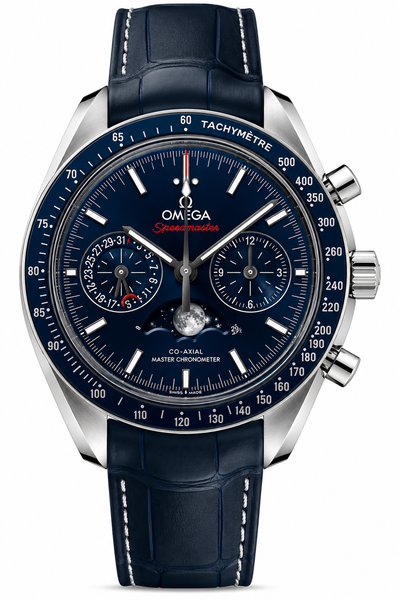
Hardly any watch sparks such passionate debate on this question as the Omega Speedmaster Moonwatch. To this day, Omega offers it with two different crystals: Hesalite and sapphire. The difference is more than a question of material; it concerns history, everyday practicality and the view of the movement.
The key points
- Hesalite is an acrylic crystal. It is lighter, does not shatter into splinters if it breaks and can usually be polished easily if scratched.
- Sapphire crystal is extremely hard. In everyday use it is virtually scratch-proof, but it can break under a hard impact.
- On the Moonwatch, the crystal also determines the caseback. The sapphire version has a transparent caseback, the Hesalite version a solid steel caseback.
What is Hesalite?
Hesalite is the brand name of an acrylic crystal, in other words a plastic. Compared with sapphire it is softer and therefore more prone to fine scratches. The advantage: light signs of wear can generally be removed with polishing paste in a few minutes. A further advantage becomes apparent if it breaks. Acrylic crystal does not shatter into sharp splinters.
This is precisely why NASA insisted on a plastic crystal in the 1960s. In the weightlessness of a space capsule, glass splinters would have posed a hazard. The Speedmaster that flew to the Moon with the Apollo astronauts was therefore fitted with Hesalite. Anyone wishing to wear a Moonwatch as close as possible to the historical original still opts for this version today.
Visually, Hesalite has a character of its own: the crystal is domed and creates slight distortions at the edges, which many collectors regard as typical of a classic watch.
What is sapphire crystal?
Sapphire crystal is synthetically produced corundum, chemically the same substance as the gemstone. On the Mohs scale it reaches a hardness of 9; only diamond is harder. In everyday use, a sapphire crystal is therefore practically scratch-proof. The downside: it is more brittle than acrylic and can crack under a hard impact. It then has to be replaced, as polishing does not help.
Almost all high-quality watches today feature sapphire crystal, usually with an anti-reflective coating that reduces glare. A comparison with other types of crystal such as mineral glass and Hardlex can be found in our article Hardlex crystal in watches.
The difference on the Moonwatch
On the current Speedmaster Moonwatch Professional, both versions are powered by the hand-wound calibre 3861, which is certified as a Master Chronometer. The sapphire version also has a transparent caseback through which the movement is visible. The Hesalite version has a solid steel caseback, just like the historical models.
In the end, it is a question of priorities: Hesalite for history and authenticity, sapphire for scratch resistance and a view of the calibre.
Everyday care
Hesalite does not resist scratches, but it does allow them to disappear. A small tube of polishing paste for acrylic crystal and a soft cloth are enough to remove fine marks from the crystal. Solvents such as acetone, on the other hand, should never come into contact with the crystal, as they can damage the surface.
Sapphire crystal requires practically no care. A microfibre cloth is sufficient to remove fingerprints. More important is protection against hard knocks to the edge, for example on door frames or table tops. A crack in sapphire crystal cannot be polished out; the crystal then has to be replaced. During a service, the watchmaker therefore also checks the fit of the crystal and the gasket to ensure that water resistance is maintained.
Examples from our range
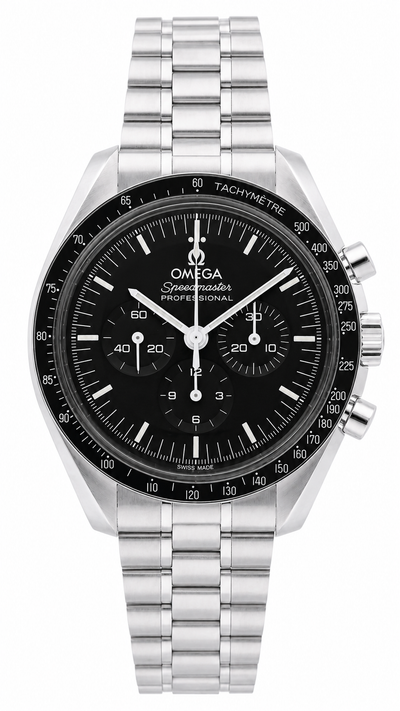
The Omega Speedmaster Moonwatch Professional 310.30.42.50.01.001 is the Hesalite version on a steel bracelet, close to the watch of the Apollo missions.
The Omega Speedmaster Moonwatch Professional 310.32.42.50.01.001 is the sapphire version with a transparent caseback. The references differ in only one place: 30 stands for Hesalite, 32 for sapphire.
You will find all versions under Omega Speedmaster Moonwatch Professional and in our complete selection of Omega Speedmaster watches.
Frequently asked questions (FAQ)
Can scratches be removed from Hesalite?
Light scratches, yes, using a polishing paste for acrylic crystal. Deep scratches or cracks require the crystal to be replaced.
Is sapphire crystal unbreakable?
No. It is highly scratch-resistant but brittle. A hard knock to the edge can crack it.
Which Moonwatch is more faithful to the original?
The Hesalite version with a solid caseback, as the watches of the Apollo missions were also fitted with Hesalite.
Conclusion
Hesalite and sapphire are not a better and a worse choice, but two answers to different questions. Those who want to wear a piece of history choose Hesalite. Those who want a watch that still looks as it did on the first day after many years choose sapphire.
Wissensdonnerstag appears every week on Instagram and Facebook. Here in our watch magazine you will find each episode in greater depth – with background, examples from our range and the most frequently asked questions.