Wissensdonnerstag #3: What is a GMT watch and what is it for?
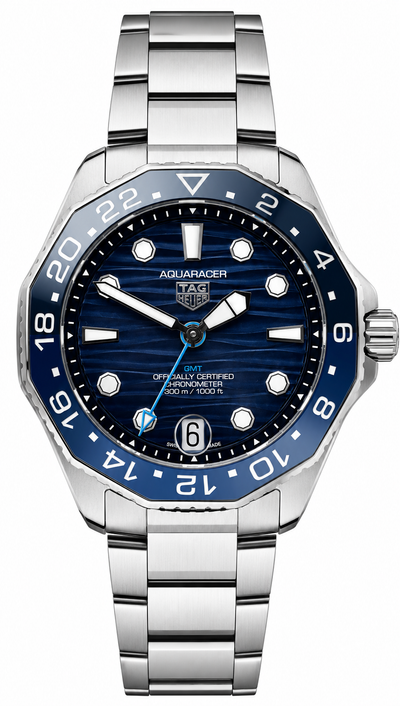
GMT stands for Greenwich Mean Time, the mean solar time at the prime meridian in the London district of Greenwich. In watchmaking, GMT refers to a function that allows a second time zone to be read alongside local time. With a rotating bezel, it can even display a third.
The key points
- An additional hand shows the second time zone. It travels around the dial only once every 24 hours.
- The 24-hour scale makes day and night legible. Whether it is 8 o’clock in the morning or the evening in the second time zone is clear at a glance.
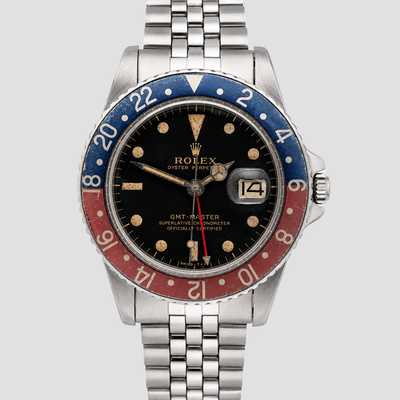
- The function originated in aviation. The Rolex GMT-Master was created in 1954 for long-haul pilots.
How the GMT hand works
The normal hour hand travels around the dial twice a day. The GMT hand takes 24 hours to do so and shows its time on a 24-hour scale located either on the dial or on the bezel. It is set to the second time zone, New York for example, while the hour and minute hands show the local time in Germany.
If the bezel rotates, a third time zone can be read: the bezel is turned by the number of hours separating the second and third time zones. The GMT hand then indicates the third time on the bezel.
Office GMT and travel GMT
Technically, there are two types of construction. With a so-called travel GMT, the normal hour hand can be adjusted in one-hour steps without stopping the watch. Travellers simply reset the hour hand on arrival, while the GMT hand, minutes and seconds keep running. The current Rolex GMT-Master II works on this principle.
With an office GMT, by contrast, the GMT hand is adjusted separately. This type is particularly suited to keeping a permanent eye on a second time zone, such as that of a business partner overseas.
The history: from Pan Am to the wrist
Regular transatlantic flights began in the 1950s. Pilots had to keep track of local time and home time simultaneously, not least because of rest periods. In 1954, Rolex presented the GMT-Master with reference 6542, developed in collaboration with the airline Pan American. The blue and red bezel, known today as the “Pepsi”, already distinguished the daytime and night-time hours back then.
The 1980s brought the GMT-Master II with an independently adjustable hour hand. A tool for aviation became one of the best-known luxury watches in the world. Where the nicknames of its variants come from is explained in Wissensdonnerstag #2.
GMT watches in everyday life
Pilots have long since ceased to be the only ones using the function. Anyone in contact with clients or family in other time zones can see at a glance whether it is a good moment to call. When travelling, home time remains visible while the watch shows local time. And those who do not travel at all can simply set the GMT hand to their own time and use the 24-hour scale as a day/night indicator.
The travel GMT offers a further practical advantage: on many models, the date changes along with the hour hand, both forwards and backwards. Anyone flying across the date line therefore does not have to reset the entire movement. On office GMT models, by contrast, the date is usually corrected via the normal time-setting function.
GMT or world time watch?
A world time watch displays all 24 time zones simultaneously, usually by means of a ring of city names around the edge of the dial. It is the more elaborate complication, but also the less clear one. For most travellers, the GMT function is entirely sufficient, as it shows precisely the time zones that matter at the moment.
Examples from our range
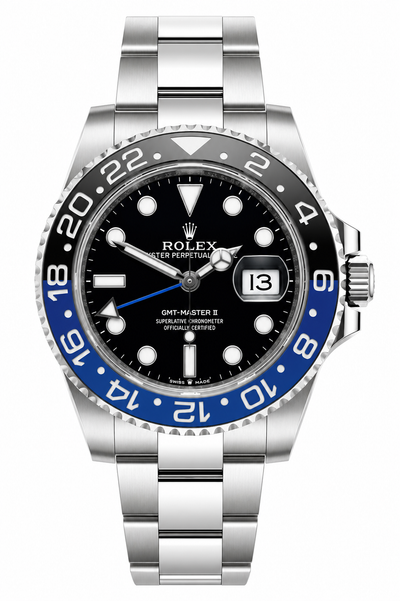
The Rolex GMT-Master II Batman shows the principle in its purest form: the GMT hand indicates the second time zone on the blue and black ceramic bezel, with the two colours separating day and night. The bezel rotates in both directions.
The Rolex GMT-Master II Sprite works in exactly the same way but has its crown on the left. The Rolex GMT-Master II Root Beer combines the function with Everose Rolesor.
You will find further models from other brands in our selection of GMT watches.
Frequently asked questions (FAQ)
How do I adjust a GMT watch when travelling?
On a travel GMT such as the GMT-Master II, the crown is pulled out to the first position and the hour hand is set to local time in one-hour steps. The GMT hand continues to show home time.
How many time zones can a GMT watch display?
Two using the hands, three with a rotating 24-hour bezel.
What do the two colours on the bezel mean?
They separate the daytime and night-time hours. This makes it clear at a glance whether it is day or night in the second time zone.
Conclusion
The GMT watch is one of the most useful complications of all: one extra hand, one extra scale, and a second time zone is always in view. The fact that it was invented for pilots is still evident today in its clear legibility.
Wissensdonnerstag appears every week on Instagram and Facebook. Here in our watch magazine you will find each episode in greater depth – with background, examples from our range and the most frequently asked questions.