













Wissensdonnerstag #13: Why does a watch glow in the dark?
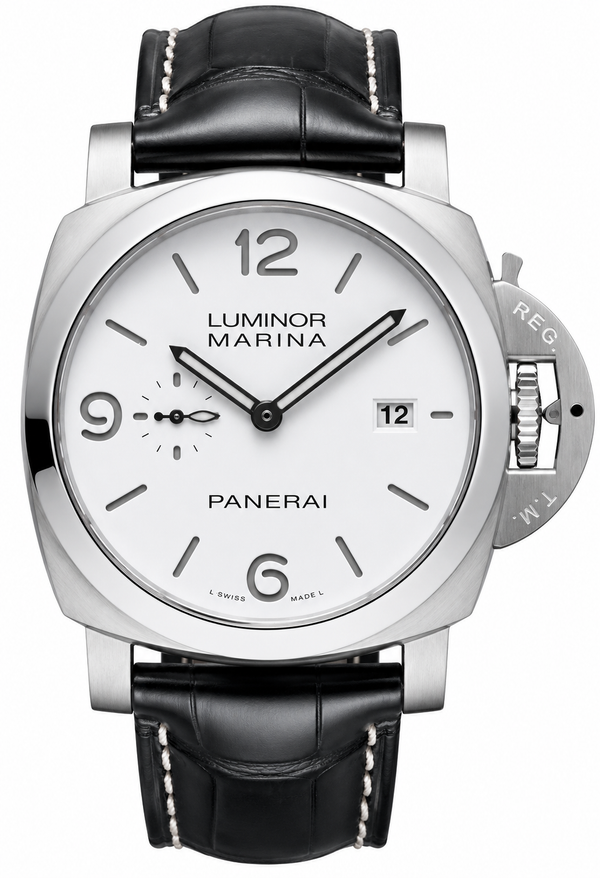
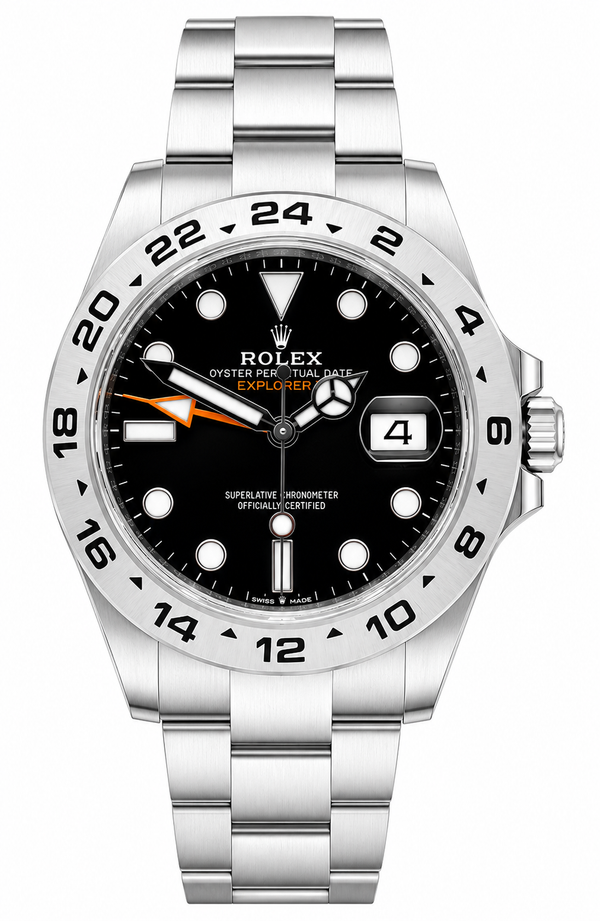
A glance at the watch in a dark bedroom, in the cinema or under water: hands and indices glow although no lamp is on. Behind this is luminous material that absorbs light and slowly releases it again in the dark. This was not always the case. The first luminous dials glowed by themselves because they contained radioactive substances. Two watches from the collection show how closely this history is linked to today's models: the Panerai Luminor Marina 44 carries it in its name, while the Rolex Explorer II relies on its own luminous material with a blue glow.
The key points
- Early luminous materials were radioactive. First radium, later tritium made dials glow without any prior charging.
- Today's luminous material stores light. Pigments based on strontium aluminate charge in daylight or under a lamp and can be recharged any number of times.
- Many brands have their own names for their lume. Super-LumiNova is widespread, while Rolex has relied on Chromalight since 2008.
Radium and tritium: Glowing by their own power
In the first decades of the 20th century, manufacturers mixed radium with a phosphor such as zinc sulphide. The radiation excited the phosphor continuously, so the dial glowed without any light source. The price was radioactivity, which was dangerous above all for the people who applied the paint by hand. From the middle of the century, tritium took over. This radioactive hydrogen isotope emits far weaker radiation but has a half-life of just over twelve years. The luminosity of older tritium dials therefore fades noticeably over the decades.
Strontium aluminate: Storing light instead of emitting radiation
In 1993, the Japanese company Nemoto developed LumiNova, a luminous material based on strontium aluminate. Since 1998, it has been produced in Switzerland under the name Super-LumiNova. The principle is called phosphorescence: The pigments absorb energy from daylight or artificial light and release it as a glow in the dark. Immediately after charging, the glow is at its brightest, after which it gradually weakens. Radioactivity no longer plays any role. The charging process can be repeated any number of times. Especially for dive watches, good legibility in the dark is a key criterion, as Wissensdonnerstag #7: What makes a true dive watch? shows.
Panerai: Luminous material as namesake
At Panerai, the names of both major lines are steeped in the history of luminous material. In 1916, the Florentine company patented Radiomir, a radium-based luminous powder that kept the instruments of the Italian Navy legible at night. In 1949 came Luminor, a new tritium-based luminous material that replaced Radiomir. Today, both names stand for entire watch families. The Luminor Marina 44, reference PAM03314, combines the distinctive crown-protecting bridge with the automatic calibre P.980, a 72-hour power reserve and water resistance to 500 metres.
Rolex Chromalight: Blue instead of green
In 2008, Rolex introduced its own luminous material: Chromalight. According to Rolex, it consists of aluminium, strontium, dysprosium and europium. In daylight it appears white, in the dark it glows blue. At first glance, this sets it apart from the typical green of many other luminous materials. The Explorer II, reference 226570, features Chromalight on its hands and indices. The line was conceived for expeditions and cave exploration, in other words for environments where the time must remain legible even without light. The calibre 3285 offers a power reserve of around 70 hours, and the additional 24-hour hand helps to distinguish day from night. How this hand works as a second time zone is explained in Wissensdonnerstag #3: What is a GMT watch and what is it for?
Examples from the collection
The Panerai Luminor Marina 44 PAM03314 pairs a silver dial with a 44 millimetre cushion case in stainless steel. The Panerai Radiomir Officine PAM01382 bears the brand's oldest luminous material name and is powered by the hand-wound calibre P.6000.

HORANDO offers the Rolex Explorer II with a black dial (226570-0002) and with a white dial (226570-0001). Both versions measure 42 millimetres and feature Chromalight on the hands and indices.

You will find further models under Panerai Luminor, Panerai Radiomir and Rolex Explorer II.
Frequently asked questions (FAQ)
Is the luminous material of modern watches radioactive?
No. Luminous materials based on strontium aluminate such as Super-LumiNova or Chromalight contain no radioactive substances. They only glow after absorbing light. Radium and tritium are found mainly in older watches.
How long does a watch glow in the dark?
This depends on the amount and quality of the luminous material and on how well it was charged. Directly after bright light, the glow is at its strongest. It then gradually fades over several hours. To eyes adjusted to the dark, well-charged indices often remain visible into the early morning. Just a short time in the light is enough to recharge the luminous material.
Can fading luminosity be restored?
Modern luminous material ages only very slowly. On older watches with tritium, however, the luminosity has usually largely faded. Reapplying lume alters the original condition of the dial and hands and can affect the collector's value. Before any such intervention, it is therefore advisable to seek advice from a partner watchmaker. How to keep dial and case protected in everyday life is described in the article Storing watches correctly.
Conclusion
Watches glow in the dark because their luminous material stores light and slowly releases it again. Radium and tritium still glowed by their own power, while today's pigments such as Super-LumiNova or Chromalight do without radioactivity. At Panerai, the names Radiomir and Luminor still recall this development, while at Rolex the blue glow of the Explorer II shows a signature of its own. Whether green or blue is more appealing remains a matter of personal taste.
Wissensdonnerstag appears every week on Instagram and Facebook. Here in the watch magazine, you will find each episode in greater detail – with background, examples from the collection and the most frequently asked questions.