










Wissensdonnerstag #12: What does power reserve mean?
Anyone who takes off a mechanical watch on Friday evening will often find it stopped by Monday. How long a movement keeps running after being fully wound is described by its power reserve. It depends on how much energy the mainspring can store and how economically the movement uses that energy. Three watches from our range show the spectrum: The Panerai Radiomir Officine runs for three days, the Tissot PRX for 80 hours and the IWC Big Pilot's Watch for seven days.
The key points
- The power reserve is the running time after a full wind. The energy is stored in the mainspring inside the barrel.
- Many classic automatic movements run for around 40 hours. That is enough for a night on the bedside table but usually not for an entire weekend.
- A longer power reserve can be achieved in two ways. Either the movement stores more energy or it consumes less of it.
How the power reserve works
The energy of a mechanical watch is held in the mainspring. It sits coiled inside a small cylindrical housing, the barrel. Winding via the crown or via the rotor of an automatic movement tensions the spring. It then slowly unwinds and drives the gear train. The escapement releases this energy in regular portions to the balance, which sets the beat of the watch.
Once the spring has fully unwound, the watch stops. The power reserve states how many hours pass between a full wind and standstill. Many classic automatic movements reach around 40 hours. How automatic and hand-wound movements tension their spring is explained in Wissensdonnerstag #5: Automatic or hand-wound – what is the difference?
Hand-wound with three days: Panerai Radiomir Officine
The Panerai Radiomir Officine, reference PAM01382, is powered by the hand-wound calibre P.6000. It stores 72 hours of power reserve, in other words three days. There is no rotor, so the energy enters the movement solely via the crown. Winding thus becomes a daily ritual. Even after three days in a drawer, the watch is still running. The balance of the P.6000 beats at 21,600 vibrations per hour.
Lower consumption: The Tissot Powermatic 80
Tissot introduced the Powermatic 80 in 2013. The automatic movement is based on the ETA calibre 2824 and achieves its 80-hour power reserve in two ways. First, the balance beats at 21,600 instead of the usual 28,800 vibrations per hour, which means it uses less energy. Second, a thinner barrel arbor core allows for a longer mainspring that stores more energy. In practice, a watch taken off on Friday evening is still running on Monday morning. Background on the Swiss base movements can be found in the article ETA movements – exclusive technology from Switzerland.
Seven days: IWC Big Pilot's Watch
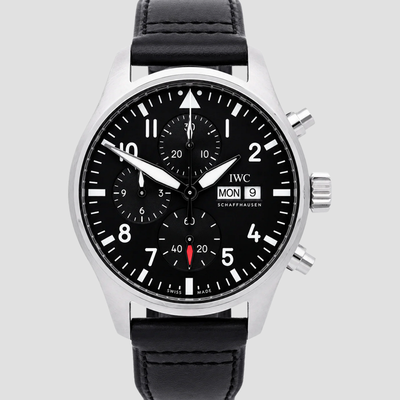
The IWC Big Pilot's Watch, reference IW501001, uses the in-house calibre 52110. It distributes its energy across two barrels and thus reaches 168 hours, or seven days. Unlike the Powermatic 80, the movement runs at the full frequency of 28,800 vibrations per hour. The Pellaton winding system uses both directions of rotor rotation, and the power reserve indicator at three o'clock shows the remaining reserve. What defines an in-house calibre is explained in Wissensdonnerstag #10: What is an in-house calibre?
Examples from our range
The Panerai Radiomir Officine PAM01382 combines the hand-wound calibre P.6000 with a 45 mm cushion case in stainless steel. The Tissot PRX Goldlünette T931.407.41.031.00 houses the Powermatic 80 in a 40 mm case of steel and yellow gold. The IWC Big Pilot's Watch IW501001 brings seven days of power reserve to a 46.2 mm stainless steel case.


You can find further models under Panerai Radiomir, Tissot PRX and IWC Big Pilot.
Frequently asked questions (FAQ)
Is a longer power reserve always better?
Not necessarily. A long power reserve is convenient in everyday life because the watch needs to be set less often. However, it says nothing about accuracy. A chronometer test is more meaningful in that respect, as Wissensdonnerstag #6 on COSC and Master Chronometer shows.
How can the remaining power reserve be read?
Some watches have a power reserve indicator on the dial, such as the IWC Big Pilot's Watch at three o'clock. This additional function is one of the complications presented in Wissensdonnerstag #8: What exactly is a complication? Without an indicator, experience with one's own watch is the best guide.
What should be done if an automatic watch keeps stopping?
If an automatic watch is worn only rarely, the movement of the wrist is often not enough for a full wind. With most automatic movements, a few turns of the crown before putting the watch on will help. For several watches worn in rotation, a watch winder is a good option, as the article Watch winders – function, origin and significance explains. If the watch stops considerably earlier than specified despite being fully wound, a partner watchmaker should inspect the movement.
Conclusion
The power reserve describes how long a mechanical watch runs without being rewound. Longer running times come from more stored energy, as with the two barrels of the IWC Big Pilot's Watch, or from lower consumption, as with the Tissot Powermatic 80. In everyday life, a long power reserve mainly means one thing: The watch needs to be set less often. Whether daily winding or seven days of running time suits better remains a matter of personal habit.
The Wissensdonnerstag appears every week on Instagram and Facebook. Here in the watch magazine you will find each episode in more detail – with background, examples from our range and the most frequently asked questions.