Wissensdonnerstag #7: What makes a genuine dive watch?
A black bezel and a steel bracelet are not enough. What makes a genuine dive watch is defined by the international standard ISO 6425. It describes what a watch must be capable of in order to serve as a tool under water.
The key points
- Water resistance of at least 100 metres. Testing is carried out with overpressure so that a safety margin remains.
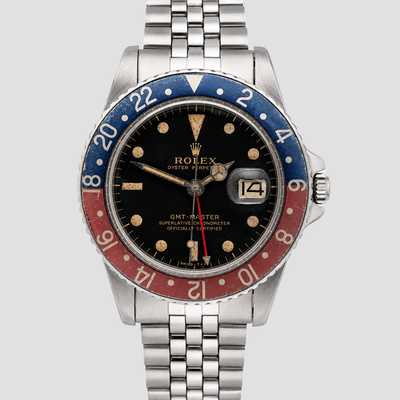
- A dive time setting that cannot be moved accidentally. As a rule, a unidirectional rotating bezel.
- Legibility in the dark. The watch must be readable from 25 centimetres in total darkness.
What ISO 6425 requires
The standard requires water resistance of at least 100 metres. Testing is carried out at 125 per cent of the stated value, so a watch rated to 300 metres is tested at 375 metres. In addition, there must be a device for preselecting the dive time and legibility in total darkness, as well as tests for shock resistance, resistance to magnetic fields, resistance to salt water and the strength of the strap or bracelet. Watches that pass all the tests may bear the inscription “Diver’s” together with the depth rating.
The bezel: any error is on the safe side
Before descending, the diver aligns the bezel marker with the minute hand. The scale then shows the elapsed dive time. The bezel only turns anticlockwise. If it is accidentally moved, the scale shows more time than has actually passed, never less. The error is always on the safe side, as the diver will then surface too early rather than too late.
Crown and helium valve
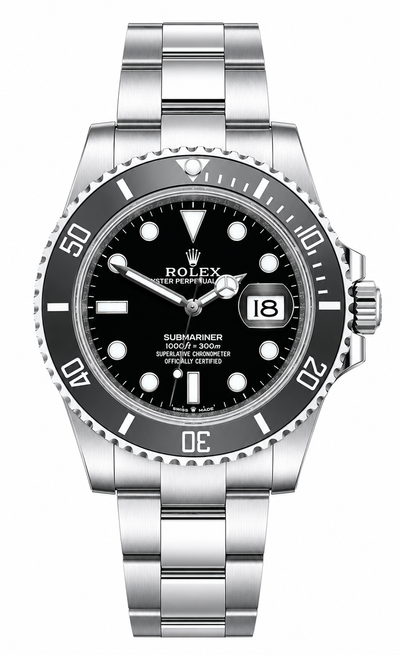
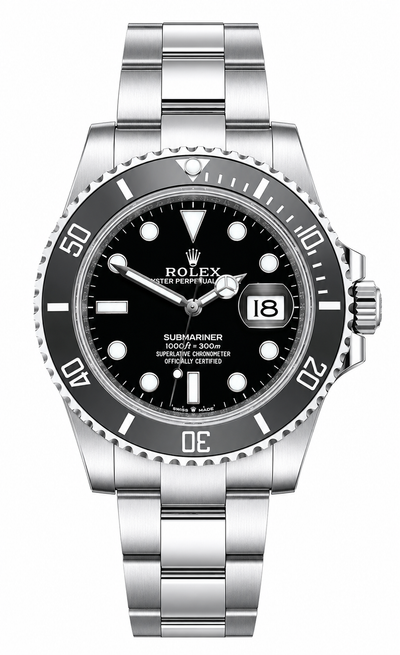
The crown is the most vulnerable opening in the case. On dive watches it is therefore screwed down. On the Submariner, Rolex uses the Triplock crown with three sealing zones.
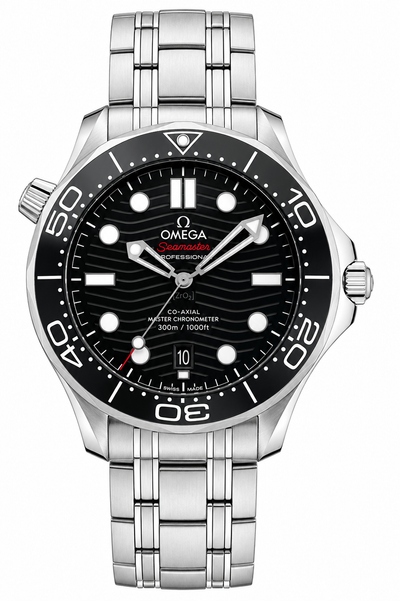
A helium escape valve, by contrast, is only important for saturation divers. They live for days in pressure chambers filled with a gas mixture containing helium. The tiny helium atoms penetrate the case through the seals. During decompression, the overpressure inside could blow out the crystal. The valve releases the gas in a controlled manner. The Omega Seamaster Diver 300M has it at 10 o’clock.
What ratings such as 3, 10 or 30 bar mean in everyday life is explained in detail in our article 100 years of the Rolex Oyster.
Luminous material and bracelet
It quickly gets dark under water. This is why dive watches have large indices and hands coated with luminous material that stores light and releases it again in the dark. The minute hand and the zero marker on the bezel must be clearly distinguishable from the rest so that dive time and the time of day are not confused. Many dive watches also have a luminous dot on the seconds hand to show that the watch is running.
The bracelet is part of the equipment too. Bracelet extensions such as the Glidelock system of the Submariner or diver’s extensions on the folding clasp allow the watch to be worn over a wetsuit. In everyday life, they allow fine adjustment to the wrist, for example in warm weather.
Examples from our range
The Rolex Submariner Date 126610LN is the epitome of the dive watch: unidirectional ceramic bezel, Triplock crown and water resistance to 300 metres.
The Omega Seamaster Diver 300M 210.30.42.20.01.001 adds the helium escape valve at 10 o’clock to the principle. This detail is not a second crown but a tool for saturation diving.
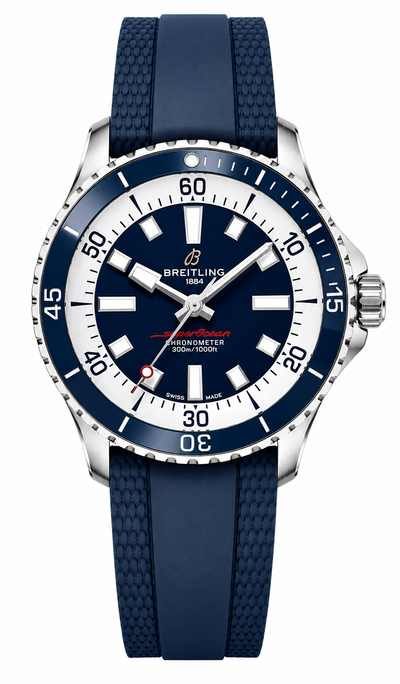
The Breitling Superocean Automatic 42 A17375E71G1A1 shows that a different brand can follow the same principle: unidirectional bezel, screw-down crown, water resistance to 300 metres and large luminous indices. The white dial with a blue bezel proves that a diving tool does not have to be black.
You will find further models in our selection of dive watches.
Frequently asked questions (FAQ)
Is every watch with 100 metres of water resistance a dive watch?
No. Water resistance is only one requirement. Without a dive time setting and legibility in the dark, it is not a dive watch within the meaning of the standard.
Do I need a helium valve?
Only for saturation diving. For recreational diving and swimming it is irrelevant.
Does the crown have to be screwed down when swimming?
Yes. A crown that has not been screwed down is the most common cause of water in the case.
Conclusion
A dive watch is recognised not by its colour but by its bezel, crown, water resistance and legibility. Anyone who knows what matters sees a Submariner not as an accessory but as a carefully designed tool.
Wissensdonnerstag appears every week on Instagram and Facebook. Here in our watch magazine you will find each episode in greater depth – with background, examples from our range and the most frequently asked questions.